10 Best Public Affairs Software in 2027

What Is Public Affairs Software?
Public affairs software is a digital tool that helps organizations track legislation, manage policymaker relationships, and run grassroots advocacy campaigns in one place, so corporations, associations, nonprofits, and agencies can monitor what government is doing across federal, state, and local levels and act on it.
Public affairs software brings the core work of government affairs into one system: tracking legislation and regulation, managing relationships with policymakers, and mobilizing supporters through grassroots campaigns. Instead of juggling spreadsheets, inboxes, and separate tools, teams monitor what the government is doing and coordinate their response in a single place.
This guide compares 10 public affairs software platforms across the main functions of the work: 1. Billflo, 2. Quorum, 3. Muster, 4. LegiStorm, 5. Bloomberg Government, 6. FiscalNote, 7. Plural (Open States), 8. POLITICO Pro, 9. LexisNexis State Net, and 10. Granicus.
How We Choose The Best Public Affairs Software For Every Function, Team Size, and Budget
Public affairs software spans several different jobs, from tracking legislation to mobilizing supporters to managing relationships with policymakers. The right tool depends first on which of these functions is your priority, and then on the size of your team and your budget. We grouped the ten platforms below by the public affairs function each one serves best.
Best Public Affairs Software Companies
The 10 Best Public Affairs Software Providers
1. Billflo: Best All-In-One Ai-Native Tracking With Live Hearing Intelligence
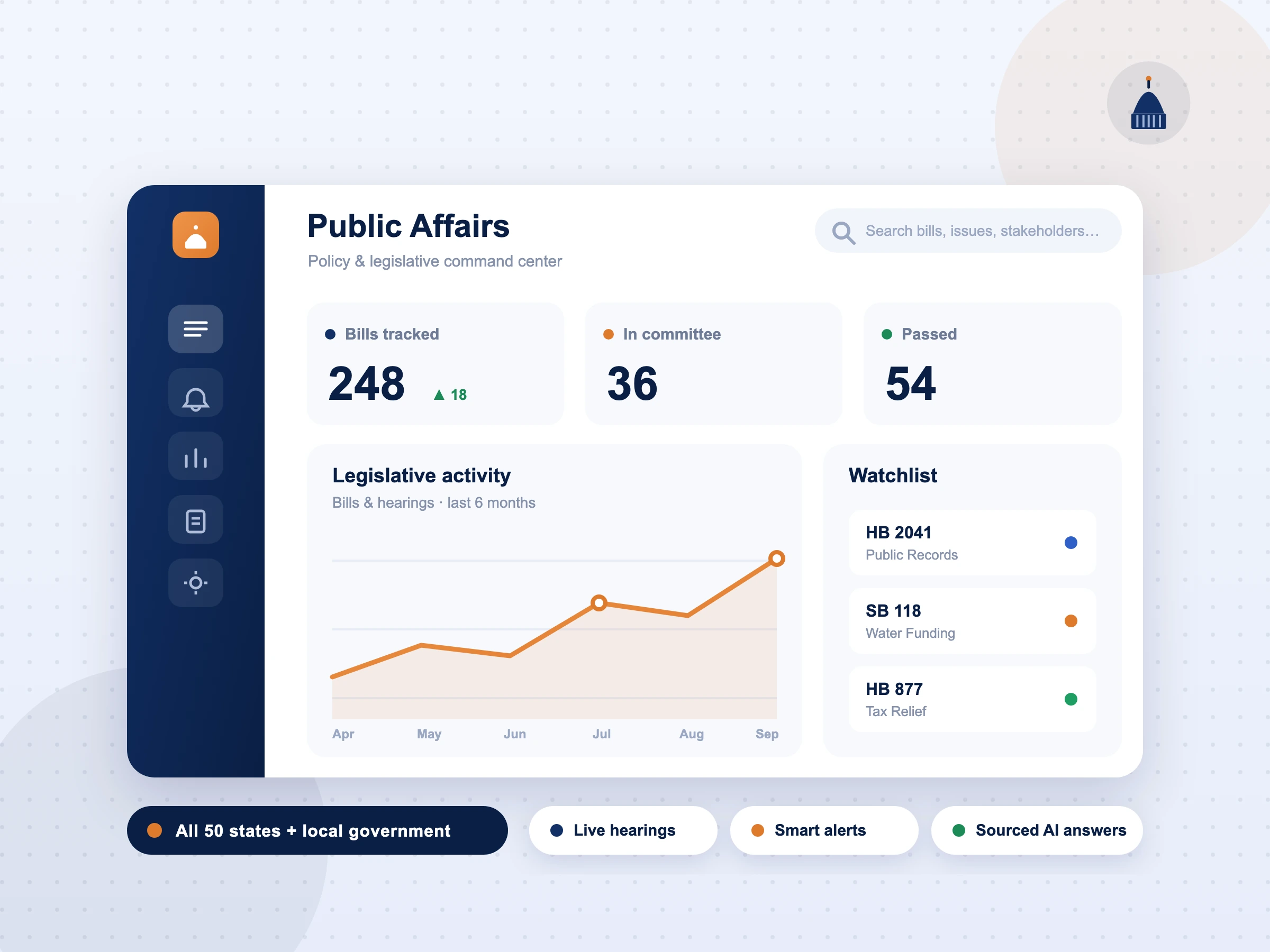
Billflo is an AI-powered public affairs platform built for teams whose work depends on knowing what the government is about to do, and what was actually said in the room. Rather than an advocacy suite, it is a legislative intelligence platform: it reads the official record, ranks bills against the issues you prioritize, summarizes what changed, and lets your team act the same day instead of days later.
Its defining capability is live session intelligence. Billflo transcribes every hearing on the calendar as it runs, with speaker identification and video timestamps that take you to the moment a tracked bill was taken up, and produces a summary within minutes of adjournment. A three-hour hearing comes back as the few minutes that bear on your bills, and a room nobody could staff is still on the record. Its AI analysis answers questions in plain English across bills, sponsors, and statuses, and every answer cites the bill it came from, so your team can verify it before repeating it to a client or a cabinet secretary.
Around that core, Billflo's legislative tracking keeps bills, notes, documents, and analysis together in projects, with fiscal figure extraction and publication-ready reports. Configurable alerts cover bills, committees, speakers, and keywords by SMS, push, and email, and collaboration and reporting keeps the team and leadership on one record. It is built for the government, with role-based access, audit trails, and secure data handling. For teams focused purely on tracking, see our guide to the best legislative tracking software.
Key features
- Live hearing transcripts with speaker identification and video timestamps: Billflo transcribes every hearing on the calendar through a searchable transcript, with speaker identification and timestamps that take you straight to the moment a tracked bill was discussed, so public affairs teams no longer have to choose which room to staff.
- Session summaries with key topics minutes after adjournment: Each hearing comes back as a concise summary of the key topics and outcomes within minutes of adjournment, so the record is ready the same day rather than days later when the official minutes are published.
- AI analysis with sourced answers that cite the bill: Ask questions in plain English across bills, sponsors, and statuses and receive answers drawn from the official record, each cited to the bill, so your team can verify a summary before putting it in front of a client or leadership.
- Alerts on bills, committees, speakers, and keywords: Configurable notifications by SMS, push, or email reach the right person the moment a tracked bill changes status, a committee schedules a hearing, or a chosen speaker or keyword comes up.
- Projects, notes, fiscal figure extraction, and reports: Keep bills, notes, and documents together by topic or agency, pull fiscal figures from the bills themselves, and produce publication-ready PDF and DOCX reports for stakeholders.
- Government-grade security and access controls: Built for public-sector and corporate government affairs work, with role-based access, audit trails, and secure data handling for sensitive policy information.
- iOS and Android apps: Track legislation, read summaries, and receive alerts from your phone, so your team stays current during fast-moving sessions and while away from the desk.
Best for: government affairs teams, agencies, associations, and lobbyists that want all-in-one AI-native legislative intelligence rather than a grassroots suite.
Coverage: all 50 states, and local governments.
Pricing: priced by agency size, with a free plan to explore the platform.
Reviews: a newer platform, so public ratings remain limited.
2. Quorum: Best Comprehensive Public Affairs Software
Quorum is the most complete platform in this list, used by thousands of teams, including Fortune 100 companies. It brings legislative and regulatory tracking, a stakeholder CRM, PAC management, and grassroots mobilization into a single system, so an organization can run its entire public affairs program without stitching tools together. Its AI assistant adds policy analysis on top.
Coverage is broad: Congress, all 50 states, local and school board levels, and international markets. That combination of breadth and function is why Quorum is the default choice for large corporate government affairs teams and major associations that need everything in one place.
The tradeoff is that a full suite is more than a team needs if the goal is only to track legislation, and it is an enterprise purchase sold by quote.
Key features
- Legislative and regulatory tracking across federal, state, local, and international levels
- Stakeholder CRM and PAC management
- Grassroots advocacy and mobilization
- AI-powered policy analysis
Best for: corporate government affairs teams, associations, and large advocacy organizations.
Coverage: federal, all 50 states, local, and international.
Pricing: quote-based.
Reviews: G2 4.3 out of 5 (175+ reviews), and a current G2 Leader in public affairs software.
3. Muster: Best For Grassroots Advocacy
Muster is a grassroots advocacy platform built to turn supporters into action. It combines action centers, targeted advocacy campaigns, AI-assisted message variations, and multi-channel email and SMS broadcasts, so associations and nonprofits can mobilize members to contact lawmakers at scale. It is consistently one of the highest-rated tools in the category.
Its strength is the connection between supporters and legislators. Muster is recognized for its public official and legislator contact databases and for district impact reporting that shows the effect of a campaign, which is what member-based organizations need most.
Muster focuses on advocacy rather than deep legislative intelligence, so teams that need hearing-level detail or research-grade tracking usually pair it with a dedicated tracking tool. It is the right choice when mobilization is the priority.
Key features
- Action centers and targeted advocacy campaigns
- AI-assisted message variations
- Multi-channel email and SMS broadcasts
- Legislator and public official contact databases
- District impact reporting
Best for: nonprofits, trade associations, and advocacy groups running member campaigns.
Coverage: federal and state.
Pricing: quote-based.
Reviews: G2 4.8 out of 5 (27 reviews).
4. LegiStorm: Best For Contact Data and Staff Intelligence
LegiStorm is the go-to resource for people's data in government affairs. It provides congressional and state-level staff directories, member intelligence, and legislative tracking, and it is widely used by nonprofits, lobbying firms, associations, and corporations that need to know exactly who to contact and how.
Its distinguishing value is the depth and accuracy of its directories. When the work depends on reaching the right staffer in the right office, LegiStorm's contact data and congressional insights are what set it apart from pure tracking tools.
It is more of a people-and-research platform than an advocacy or mobilization suite, so teams running grassroots campaigns typically combine it with other tools. Pricing is published, which is uncommon at this level of the market.
Key features
- Congressional and state staff directories
- Member and office intelligence
- Legislative tracking
- Contact data refreshed regularly
Best for: government relations professionals who need direct contact data and office insights.
Coverage: Congress and states.
Pricing: published plans starting around $199 per month.
Reviews: G2 4.6 out of 5 (16 reviews).
5. Bloomberg Government: Best For Federal Policy Intelligence
Bloomberg Government, or BGOV, pairs legislative and regulatory tracking with original policy news, analysis, and stakeholder analytics. It sits inside the broader Bloomberg ecosystem, so government affairs teams get policy monitoring alongside the reporting and data they already work from.
It is strongest at the federal level, which makes it a natural fit for federal contractors, law firms, and teams focused on Congress and the agencies. Users value the depth of its policy intelligence, its regulatory news monitoring, and its legislative research.
It is less focused on direct legislator-contact and grassroots mechanics than the advocacy suites, and like most tools at this tier it is a quote-based subscription with lighter state coverage than its federal depth.
Key features
- Federal and state legislative and regulatory tracking
- Original policy news and expert analysis
- Stakeholder analytics
- Directories and research tools
Best for: federal contractors, law firms, and federal-facing government affairs teams.
Coverage: federal-heavy, with lighter state coverage.
Pricing: quote-based subscription.
Reviews: around 4.0 out of 5 on G2.
6. FiscalNote: Best For Enterprise Policy Analytics
FiscalNote is an enterprise policy monitoring and government relations platform, built around AI-driven analysis of legislative and regulatory data. It combines policy tracking with nonpartisan analysis and mobilization tools, and it is positioned for large organizations that need to monitor risk across many jurisdictions and turn a large flow of data into structured insight.
Its strengths are wide coverage and analytics, spanning local to global tracking, with workflow automation and modern AI access. That depth appeals to enterprise teams that need forecasting and executive-ready outputs rather than a bill list alone.
As with other enterprise suites, that depth comes with scale: onboarding takes effort, and pricing is quote-based at the high end of the market, so it suits well-resourced teams more than smaller ones.
Key features
- AI-driven legislative and regulatory analysis
- Local-to-global policy tracking
- Nonpartisan analysis and mobilization tools
- Workflow automation and AI access
Best for: enterprise government affairs teams assessing policy and regulatory risk at scale.
Coverage: federal, state, and global.
Pricing: quote-based, at the enterprise end of the market.
Reviews: around 4.0 out of 5 on G2.
7. Plural (Open States): Best For Modern Tracking with Transparent Pricing
Plural grew out of the Open States project, which has provided open access to state legislative data for years. That lineage gives it a strong data foundation and a following among teams that value open tooling and modern AI.
What distinguishes it is the combination of real AI features and pricing that is published rather than quoted. It offers clear tiers, modern analysis built on open data, and coverage of all 50 states and Congress, which suits organizations that want to evaluate and buy without a lengthy enterprise procurement.
It focuses on tracking rather than full advocacy or CRM, so it sits between free raw data feeds and the larger suites. It is a strong option when predictable pricing and modern tracking matter more than a complete public affairs toolkit.
Key features
- AI-assisted bill tracking and search
- Open-data foundation (Open States)
- Published, transparent pricing
- Alerts and analysis
Best for: teams that want modern tracking with pricing they can see in advance.
Coverage: all 50 states and Congress.
Pricing: published tiers.
Reviews: G2 5.0 out of 5 (one review); Capterra 4.9 out of 5.
8. POLITICO Pro: Best For Policy News and Intelligence
POLITICO Pro is a specialized policy intelligence platform that pairs legislative and regulatory trackers with original journalism and source documents. Its trackers and policy compasses sit alongside agency transcripts, bill texts, and the reporting POLITICO is known for, which makes it a strong fit for teams whose work is driven by federal policy developments.
Its value is the combination of news and primary sources in one place. For federal-facing government affairs and communications teams, being first to understand a development, and reading the underlying document, is the core use case.
It is more of a news and intelligence service than an advocacy or stakeholder-management tool, and it is sold as an enterprise subscription by quote.
Key features
- Legislative and regulatory trackers
- Policy news and analysis
- Original source documents, including agency transcripts and bill texts
- Policy compass tools
Best for: federal-facing and communications teams that need policy news with intelligence.
Coverage: federal-heavy.
Pricing: quote-based subscription.
Reviews: limited verified public ratings in this category.
9. LexisNexis State Net: Best For Compliance Research
LexisNexis State Net is a long-standing legislative and regulatory tracking service covering all 50 states and Congress. Its reputation rests on authoritative, research-grade data, and it is the platform that compliance, legal, and research teams tend to trust when the stakes are high.
Its principal strength is that it tracks both bills and the regulations that follow them, from a source few would question. For organizations in heavily regulated industries, that combination is the primary reason to consider it.
It reads as a data and research platform rather than a modern public affairs suite, and pricing is provided by quote. Public reviews are limited and mixed, so it is best judged on data quality and fit rather than ratings.
Key features
- Legislative and regulatory tracking together
- All 50 states and Congress
- Research-grade, authoritative data
- Alerts and reporting
Best for: legal, compliance, and research teams.
Coverage: all 50 states and Congress.
Pricing: quote-based.
Reviews: around 3.0 out of 5 on third-party sites, from few reviews.
10. Granicus: Best For Government-To-Citizen Engagement
Granicus is a public-sector platform focused on the other side of public affairs: how government agencies communicate with and serve citizens. It provides digital communications, public meeting and agenda tools, and engagement services used widely across government at every level.
Its value is reach and trust in government-to-citizen communication, from digital newsletters to public records and meeting management. For agencies and public-sector teams, it is the engagement layer rather than a legislative-tracking or advocacy tool.
Because it serves a different purpose from the tracking and advocacy platforms above, Granicus is best evaluated on its citizen-engagement capabilities, not on legislative intelligence.
Key features
- Government-to-citizen digital communications
- Public meeting and agenda management
- Engagement and outreach tools
- Public-sector record and transparency tools
Best for: government agencies and public-sector teams engaging citizens.
Coverage: government agencies across levels.
Pricing: quote-based.
Reviews: ratings vary across its product suite.
How We Evaluated These Public Affairs Tools
Public affairs software is a broad category, so we evaluated each platform against the capabilities that matter most across the work:
- Legislative and regulatory tracking: real-time alerts and summaries of bills, rules, and local ordinances across federal, state, and municipal bodies.
- Stakeholder management: databases that log meetings, calls, emails, and lawmaker contact details.
- Grassroots advocacy: action centers, petitions, and multi-channel outreach to mobilize supporters.
- AI analysis: plain-language summaries and answers, ideally cited back to the source.
- Live session and hearing coverage: transcripts and testimony, not just bill status.
- Analytics and reporting: dashboards and exports that communicate impact to leadership.
- Coverage, security, and pricing: the jurisdictions covered, government-grade data handling, and whether pricing is published or quote-based.
No single tool leads on all of these, which is why the right choice depends on your primary function.
What Public Affairs Software Includes
Most public affairs solutions combine four core capabilities, and platforms differ mainly in which they emphasize:
- Legislative and regulatory tracking: monitoring bills, rules, hearings, and votes across jurisdictions.
- Stakeholder CRM: a central record of relationships, meetings, and policymaker contacts.
- Grassroots advocacy: tools to mobilize supporters and generate messages to lawmakers.
- Analytics and reporting: measuring engagement, campaign effectiveness, and impact.
A full public affairs management program may use one comprehensive suite, or pair a specialist tool for each capability.
Choose The Right Public Affairs Software For Your Team
If you work in public affairs, you know the pressure: legislation moves faster than any team can read, the decisions that matter are made in hearings you cannot all attend, and the official record catches up days later. The right software closes that gap, but the right choice depends on your primary job, whether that is tracking legislation, mobilizing supporters, or managing relationships.
For teams whose priority is knowing what is happening in the legislature, and what was said about it, Billflo is built for exactly that. As an AI-powered public affairs platform, it combines legislative tracking, live session intelligence, AI analysis, and alerts in one place, with every AI-assisted answer cited to the official record. Billflo covers Congress, all 50 states, and local government, and offers a free plan, so your team can evaluate it before committing. If legislative tracking is your sole focus, our guide to the best legislative tracking software compares the options in detail.
See it running on your statute
Billflo normalizes bill data across jurisdictions, alerts on the events that change a measure’s prospects, and turns hearings into searchable summaries.
Frequently asked questions
Public affairs is a strategic discipline that combines communication and relationship management to help an organization engage with government bodies, legislators, the media, and community stakeholders. The aim is to influence public policy and shape the regulatory environment in ways that protect and advance the organization's interests.
A public affairs company, often called a public affairs firm or agency, is a consultancy that organizations hire to manage their engagement with government and the public. It advises clients on policy strategy, monitors and analyzes legislation and regulation, represents their interests to lawmakers and regulators, and runs communications and advocacy campaigns on their behalf. Companies turn to these firms when they lack an in-house government affairs team or need specialized expertise in a particular issue, jurisdiction, or level of government.
Effectively yes. "Public affairs software," "government affairs software," and "government relations software" describe the same category and audience. Public affairs is the broader term, and government affairs is the policy-facing part of it, but buyers use them interchangeably.
Public affairs and public relations are closely related communication disciplines, and many organizations use both, but they serve different audiences and goals. The simplest distinction is that public affairs manages an organization's relationship with government and policy, while public relations manages its relationship with the broader public.
Public affairs is the policy-facing discipline. It centers on government bodies, lawmakers, regulators, and community stakeholders, with the goal of influencing legislation and shaping the regulatory environment, through monitoring bills and rules, building relationships with policymakers, and running advocacy campaigns.
Public relations is the audience-facing discipline. It centers on the general public, customers, and the media, with the goal of shaping how the organization is perceived, through press coverage, brand messaging, storytelling, and crisis communication.
Pricing ranges from published plans to enterprise contracts. A few tools publish pricing, for example from around $199 per month, or transparent tiers, while the enterprise suites are quote-based and scale with seats, modules, and integrations. Billflo is priced by agency size and offers a free plan to start.
Billflo is the best public affairs software for teams that need to know what is happening in the legislature and what was said in the room. It is an AI-powered public affairs platform that brings real-time legislative intelligence into one system:
- Legislative tracking across Congress, all 50 states, and local governments.
- Live hearing coverage that transcribes every hearing with speaker identification and timestamps.
- AI analysis that answers questions in plain English, with every answer cited to the official record.
- Alerts on the bills, committees, speakers, and keywords you follow.
- Government-grade security, with role-based access and secure data handling.
- A free plan, so your team can evaluate it before committing.
For public affairs, government affairs, and agency teams, Billflo delivers same-day legislative intelligence that most tools, which stop at bill status, cannot.
For legislative monitoring and intelligence, Billflo, FiscalNote, and Plural are the strongest fits, with Billflo the best choice for AI-native tracking and live hearing coverage. See our guide to the best legislative tracking software for a detailed comparison.

Live hearings, change alerts, and plain-language summaries for the bills you follow.