Grassroots Advocacy in 2027: Planning Around the Legislative Calendar

What Is A Grassroots Advocacy Plan?
A grassroots advocacy plan is the written strategy an organization uses to mobilize its supporters, members, employees, or the public, to influence legislation. Where direct lobbying is the organization's own conversation with a lawmaker, grassroots advocacy is the organized voice of constituents behind it: the emails, calls, testimony, and visits that show a legislator their district cares about an issue. The plan is what makes that effort deliberate instead of reactive, tying each action to a specific bill, a specific decision-maker, and a specific moment in the legislative calendar.
A good plan answers five questions: what are we trying to achieve, which bills and lawmakers matter, who are our advocates, what do we ask them to do, and when do we ask. Get those right and a small organization can influence outcomes well beyond its size. Get them wrong and you flood supporters with alerts they learn to ignore.
Grassroots Advocacy vs. Direct Lobbying
The two strategies are complementary, and most effective programs run both. The difference is who delivers the message.
The two are strongest when they are coordinated. The lobbyist's meeting lands harder when a committee member is already hearing from constituents back home, and the constituent emails carry more weight when the organization's expert is in the room to answer questions.
Grassroots vs. Grasstops
It also helps to separate two kinds of supporter outreach:
- Grassroots is broad pressure from the wider base: large numbers of everyday members and constituents in a district.
- Grasstops is narrower and higher-leverage: a handful of trusted local figures, board members, major employers, or community leaders who already have a direct line to a lawmaker.
A strong plan uses both. Grassroots shows a legislator that an issue has a real constituency behind it; grasstops gets you the meeting.
Why You Need A Plan, Not Just A List Of Alerts
Most advocacy programs fail the same way: they react. A bill surfaces, someone sends a panicked "contact your legislator" email, and it goes out after the committee has already voted. The problem is rarely effort; it is timing and focus. A plan fixes both. It decides in advance which issues are worth your supporters' attention, and it schedules questions around the moments when a legislator can actually be influenced, before a committee hearing, ahead of a floor vote, during the narrow window when a bill is live.
That is why the foundation of any grassroots plan is intelligence: knowing what is moving, where it is in the process, and when the next decision point is. Without that, the calendar and cadence below are guesswork.
Step 1: Set Clear, Measurable Goals
Start with outcomes, not activity. "Raise awareness" is not a goal; "secure five committee members' support for SB 100 before the March 15 hearing" is. For each priority, define the policy result you want, the decision-makers who control it, and the measure of success (messages sent, meetings held, co-sponsors added). Tie every goal to a bill or a clearly defined issue so your supporters always know exactly what they are working toward.
Step 2: Identify Your Priority Issues and Bills
You cannot mobilize on everything, and you should not try. Decide which issues are core to your mission, then find the specific bills that touch them across the states where you operate. This is where most of the work happens, and where legislative tracking earns its place: filtering thousands of introductions down to the short list that actually matters, so your plan targets real measures rather than vague themes. Rank that list by impact and by how winnable each fight is, and focus your supporter energy on the top few.
Step 3: Map Your Decision-Makers
For each priority bill, identify who holds the leverage: the committee of jurisdiction, the chair, the swing members, and the bill's sponsors and opponents. Grassroots advocacy works when the right constituents reach the right legislator at the right time, so a message from a lawmaker's own district is worth far more than a flood of out-of-district noise. Segment your advocates by district and match them to the members who represent them.
Step 4: Build, Segment, and Expand Your Base
Your advocates are your capital. Build a list of members, employees, partners, and supporters, and segment it by location, issue interest, and willingness to act. Know who your "super-advocates" are, the people who will testify, write an op-ed, or meet a legislator in person, versus the broader base you will ask for a quick email or call.
This is also where coalitions multiply your reach. Partner with nonprofits, trade groups, and local leaders who share the goal, so a single bill draws constituents from several organizations at once. The more precisely you can target an ask, and the more organizations standing behind it, the higher your response rate and the more weight it carries.
Step 5: Craft Your Message and Your Asks
Give supporters something specific to do and say. Define the ask for each action (support SB 100, oppose the amendment, attend the hearing), and provide a short, editable message they can personalize. Keep it concrete and local: what the bill does, how it affects this district, and exactly what you want the legislator to do.
Two things lift response and impact:
- Personal stories: Lawmakers are moved by real constituent experiences far more than by institutional talking points. Collect and surface the stories that show what a bill does to real people.
- Multiple channels: Combine quick digital actions (emails, calls, petitions) with higher-effort ones (testimony, in-person meetings, local town halls), and match the channel to the supporter's level of engagement.
A clear, easy ask is the single biggest driver of whether a supporter actually acts.
Step 6: Build The Advocacy Calendar Around The Legislative Session
This is where a plan becomes real. Map your actions to the legislative calendar: filing deadlines, committee hearing dates, crossover, floor votes, and sine die. Each milestone is an activation point. A hearing two weeks out is the moment for testimony and a targeted email push to the committee; an approaching floor vote is the moment for calls to the full chamber. Working backward from those dates tells you when to warm up supporters, when to make the ask, and when to follow up.
Build in slack for volatility. Bills move fast and amendments appear with little notice, so leave room to activate on short notice rather than planning a rigid, fixed schedule. For the session dates themselves, start from a current legislative calendar for the states you cover.
Step 7: Set Your Cadence
Cadence is how often and under what triggers you go to your supporters. Too frequent and they tune out; too rare and they are not ready when it counts. The fix is to make cadence event-driven rather than calendar-driven: you activate when a tracked bill reaches a key stage, not on an arbitrary schedule. Configurable alerts on your priority bills, committees, and hearings are what let you time an ask to the moment it matters, instead of guessing.
Step 8: Choose Your Tools
A grassroots program usually runs on two kinds of tools, and it helps to keep them straight:
- Mobilization tools, the advocacy software that actually sends the emails, hosts the action center, and routes calls to legislators.
- Legislative intelligence, the layer that tells you what to mobilize on and when: which bills are moving, what changed in the latest amendment, and when the next hearing or vote is.
Billflo is the second kind. It does not send your supporter emails; it tells your team which bills and hearings to build the plan around, so the mobilization tool fires at the right target and the right time.
Step 9: Measure and Refine
Track the numbers that show influence, not just activity: messages sent, unique advocates engaged, meetings secured, co-sponsors added, and ultimately the bill outcomes. Review after each major push and after the session ends, and report wins back to your coalition to keep momentum for the next cycle. The programs that improve are the ones that treat the plan as a living document, not a binder.
Common Grassroots Advocacy Tactics
Within a plan, most organizations draw on the same set of proven tactics. Match each to the moment and the supporter, rather than using all of them at once.
- Digital outreach: online petitions, email campaigns, click-to-call tools, and social media sharing. The lowest barrier to entry and the easiest to scale.
- In-person action: town halls, community meetings, lobby days, and scheduled visits to legislative offices. Higher effort, higher impact.
- Letter and email campaigns: still the most common form of grassroots outreach, because a steady volume of constituent messages is visible and hard for an office to ignore.
- Educational assets: fact sheets, toolkits, and talking points that lower the barrier to participation and keep the message consistent.
- Personal testimony: constituents telling their own story at a hearing or in writing, which carries more weight than any institutional statement.
A Note For 501(C)(3) Nonprofits
If your organization is a 501(c)(3), grassroots lobbying is regulated and limited, so it is worth knowing the line. Under IRS guidance, a communication is generally treated as grassroots lobbying when it refers to specific legislation, reflects a view on it, and includes a call to action urging the recipient to contact a lawmaker. Nonpartisan education and research usually fall outside that definition. This is general information, not legal advice; confirm your limits and report with counsel before you build the plan around them.
Common Grassroots Advocacy Mistakes To Avoid
If you run an advocacy program, whether on a government affairs team, at an association, or in a nonprofit, these are the errors that quietly cost you results. Even a well-resourced program loses ground to a handful of recurring mistakes, and each one is avoidable once you know what it looks like.
- Activating too late: The most common and most costly mistake. A bill clears committee or passes a key vote before the team even knows it moved, so the supporter push goes out after the decision is already made. By then a legislator's position is set and the window to influence it has closed. The fix is upstream: track your priority bills continuously and set alerts on the stages that matter, so you are mobilizing days before a hearing, not reacting the day after it.
- Over-asking: When every bill triggers an "urgent, act now" alert, supporters stop being able to tell what is actually urgent, and they tune out. Advocacy attention is a limited resource, and spending it on low-stakes measures leaves nothing for the fights that count. Reserve full mobilization for your top priorities, and use lighter touches, or no ask at all, for everything else.
- Vague asks: "Make your voice heard" or "tell your legislator to do the right thing" leaves a supporter unsure what to say, to whom, and by when, so most do nothing. A strong ask names the specific bill, states the position (support or oppose), identifies the right recipient, and gives a short, editable message. The easier you make it to act, the more people actually act.
- Out-of-district noise: A legislator weighs messages from their own constituents far more heavily than messages from anyone else, because those are the people who vote for them. A flood of identical emails from across the state, or from people outside the district entirely, gets discounted or ignored. Match each supporter to the lawmaker who actually represents them, and prioritize constituents of the members you are trying to move.
- No measurement: If you are not tracking what you sent, who acted, and what happened to the bill, you cannot tell which tactics worked, repeat your wins, or show leadership that the program earns its budget. Decide your metrics before the campaign starts (messages sent, unique advocates, meetings secured, co-sponsors added, outcomes), and review them after each push.
Powering Your Grassroots Advocacy Plan With Billflo
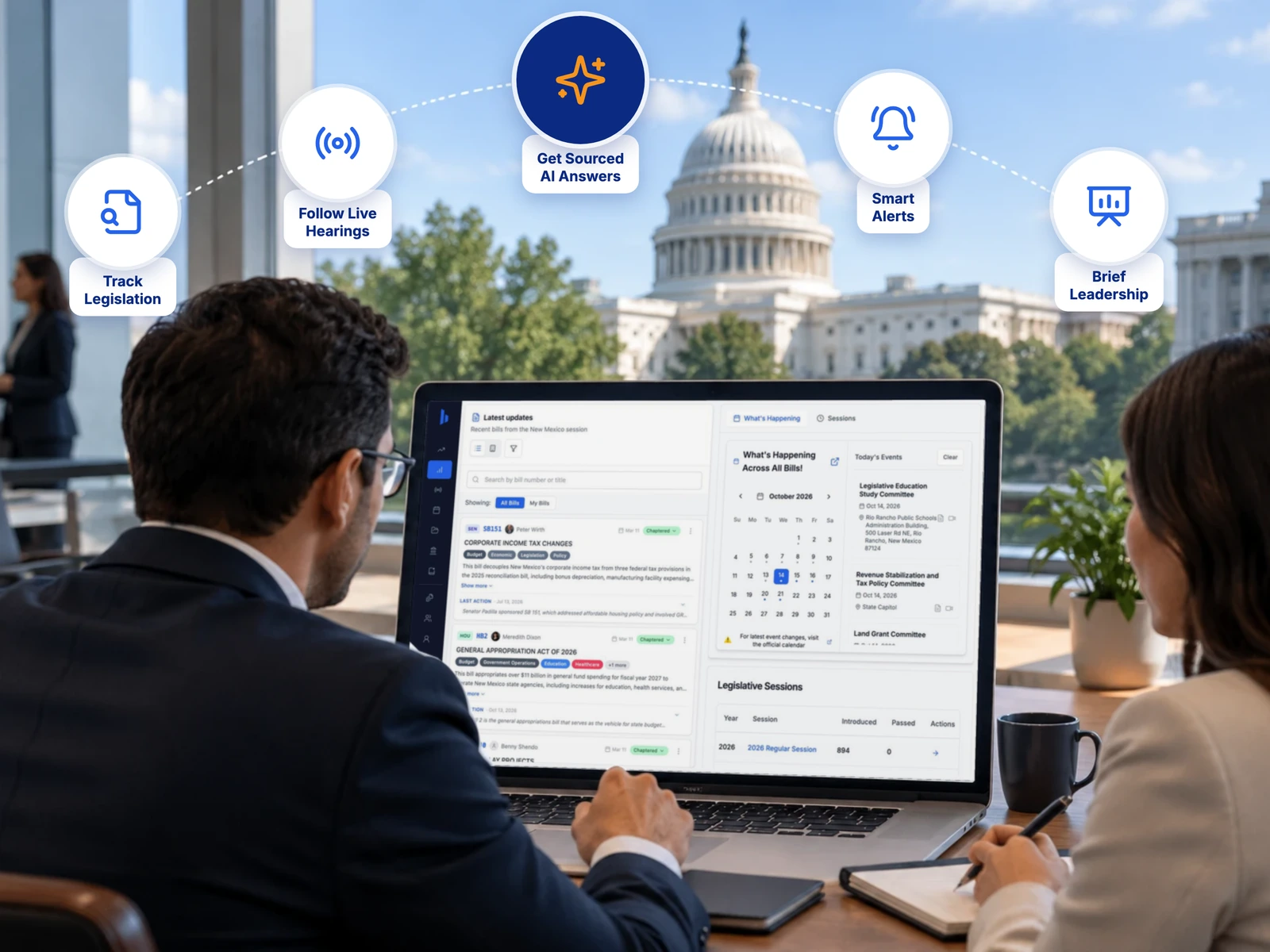
Billflo is an AI-powered public affairs platform that provides the intelligence a grassroots plan runs on, across all 50 U.S. states and local governments. It does not replace your advocacy or mobilization software; it makes that software effective by telling you what to activate on and when.
- Know what to mobilize on: Billflo's AI analysis ranks and summarizes bills against your issues, so your plan targets the measures that matter, with every answer cited to the bill.
- Time the calendar and cadence: Live session intelligence and configurable alerts tell you when a hearing is set and when a bill reaches a key stage, so your asks land before the vote, not after.
- Keep the team aligned: Collaboration and reporting keep your priority bills, notes, and status in one shared record, so everyone is working the same plan.
Billflo covers state and local legislation and is built for government affairs teams, associations, and nonprofits that need to act the day a bill moves. There is a free plan to start.
Frequently asked questions
Grassroots advocacy is the practice of mobilizing everyday citizens and constituents to contact their legislators and influence public policy and legislation from the ground up, through emails, calls, petitions, and testimony rather than through the organization’s direct lobbying alone.
A grassroots advocacy plan is a written strategy for mobilizing supporters, members, employees, or the public, to influence specific legislation, by tying each action to a bill, a decision-maker, and a moment in the legislative calendar.
Direct lobbying is your organization's own communication with a lawmaker or their staff. Grassroots advocacy mobilizes constituents to deliver the message instead, through emails, calls, testimony, and visits. Most effective programs use both and coordinate them.
Grassroots is broad pressure from the wider base of everyday members and constituents. Grasstops is narrower, high-leverage outreach through trusted local figures who already have access to a lawmaker. A strong plan uses both.
Letter and email campaigns are the most common form, because a steady volume of constituent messages is visible to an office and easy for supporters to take part in. Phone calls, petitions, and town halls are close behind.
Map your actions to the legislative session: filing deadlines, committee hearings, crossover, and floor votes. Work backward from each milestone to decide when to warm up supporters, when to make the ask, and when to follow up, and leave room to activate on fast-moving bills.
Two kinds: a mobilization tool that sends supporter emails and hosts the action center, and a legislative intelligence platform that tells you what to mobilize on and when. Billflo provides the intelligence layer; a separate advocacy tool handles the outreach.

Live hearings, change alerts, and plain-language summaries for the bills you follow.