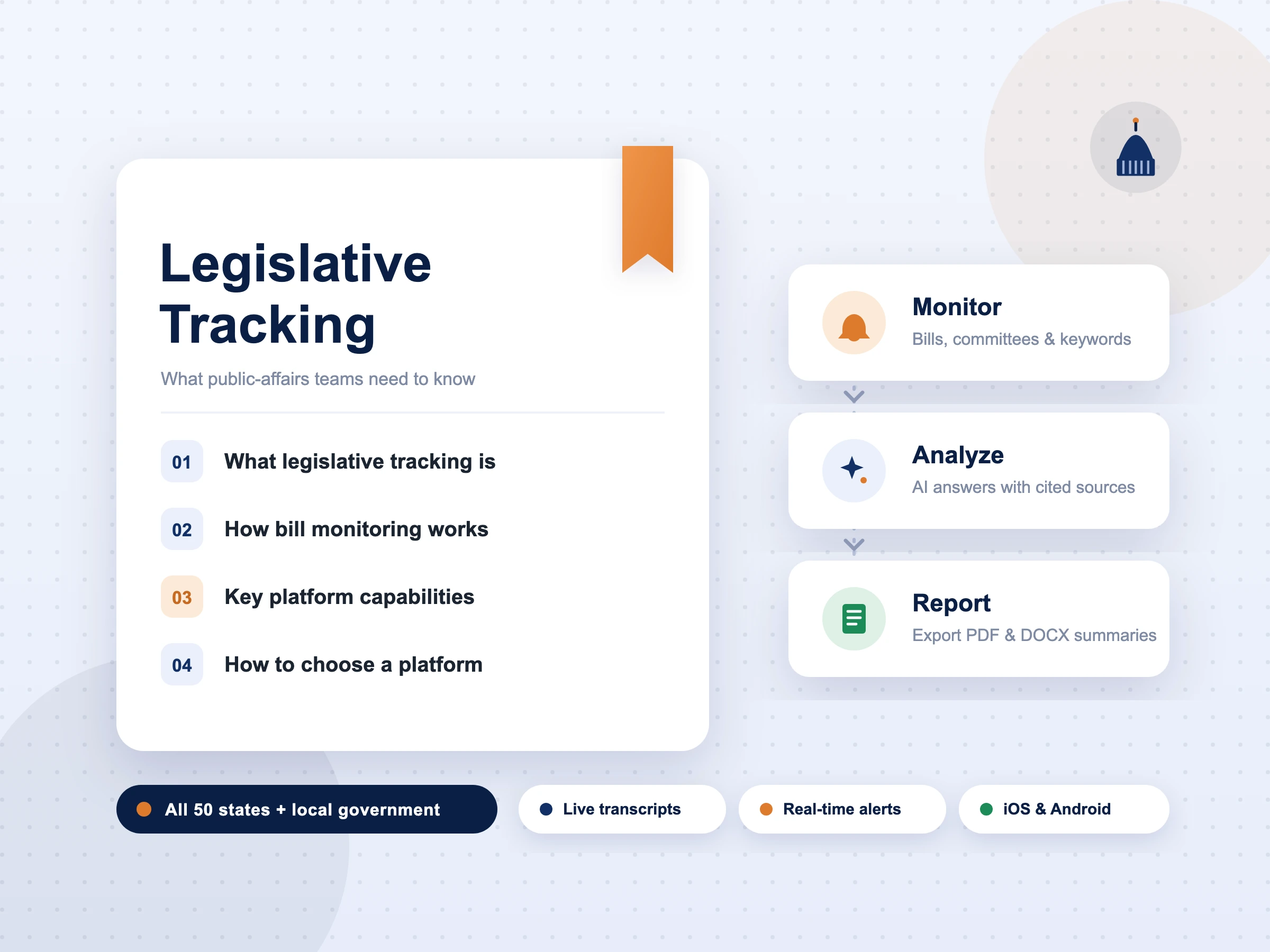
A Guide to Legislative Tracking

What Is Legislative Tracking?
Legislative tracking is the practice of following a bill through every stage of the legislative process, from introduction and committee review to hearings, amendments, floor votes, and final passage or defeat. Rather than checking each step by hand, a team monitors those changes continuously and acts when a bill reaches a stage that matters to them.
For any organization with interests before the government, that visibility is essential. A single session can generate thousands of measures, and the bills that carry real consequences for a given organization are a small fraction of the total. Legislative tracking provides a disciplined method for identifying those measures early, following them through each stage of the process, and preparing a position while there is still time to affect the outcome.
Why Legislative Tracking Matters
A legislative session produces far more activity than any individual can review, and the measures that bear on a particular organization are a small share of the whole. Without a reliable process for monitoring that activity, a team may learn of a consequential change only after a statute has taken effect or after the window to influence it has closed. Consistent tracking converts that activity into a manageable, prioritized record, and in doing so delivers several concrete benefits:
- Time saved: Automated monitoring eliminates the hours otherwise spent searching individual legislative websites.
- Comprehensive coverage: Systematic monitoring reduces the risk that a relevant measure advances unnoticed.
- Earlier action: Prompt awareness of status changes allows a team to act while there is still time to shape an outcome.
- Shared visibility: A central record keeps staff and leadership aligned on what is being tracked and what requires attention.
- Multi-jurisdiction scale: A single consolidated view replaces the burden of monitoring numerous state systems separately.
- Defensible reporting: Clear summaries and exports communicate legislative developments to leadership, members, and clients.
How The Legislative Process Works
Effective tracking depends on understanding the path a bill follows. Procedures differ between Congress and the individual states, but the sequence is broadly consistent.
- Introduction: A member sponsors and introduces a bill, which is assigned a bill number. This is the earliest signal and the point at which tracking should begin.
- Committee referral: The bill is referred to the committee of jurisdiction. This is where much of the substantive work occurs, and where a large share of bills die without further action.
- Hearings: The committee holds hearings at which testimony is received and the bill is debated. What is said in a hearing often carries more weight than the text of the bill itself.
- Markup and amendments: The committee amends the bill. Because amendments can change its substance considerably, tracking the specific version, and not merely the title, is essential.
- Floor action: If the bill is reported out of committee, the full chamber takes it up for debate and a vote. The measure then generally repeats the process in the second chamber, subject to that chamber's crossover deadlines.
- Reconciliation: If the two chambers pass differing versions, they must reconcile them into a single text before final passage.
- Executive action: The governor or the president signs the bill into law, vetoes it, or allows it to become law without signature.
Each stage is a point at which a measure can advance, stall, change materially, or fail. Tracking a bill means following it across all of them, through the close of the session.
What Legislative Tracking Involves
Tracking is more than observing a status line change. A thorough effort attends to several things at once:
- Bills and resolutions that match your issues, identified by keyword, topic, or sponsor: These are the measures at the center of your program. Identifying them at introduction gives your team the most time to respond.
- Amendments and version changes, since a single revision can convert a favorable bill into an unfavorable one: The decisive change often appears in a late amendment, not the introduced text. Following each version, rather than the title alone, prevents your team from being caught unprepared.
- Committee activity and hearings, including schedules and testimony: Much of a measure's fate is decided in committee rather than on the floor. Monitoring hearing calendars and testimony indicates where a bill is genuinely headed.
- Votes, in both committee and the full chamber, and how individual members align: Vote records confirm where a measure stands and who supports or opposes it. They also establish the positions and relationships that will matter on future measures.
- Sponsors and stakeholders, which indicate who is advancing a measure and whom to engage. The sponsor and coalition behind a bill signal how serious it is and how far it may advance. They also identify the offices your team should approach.
- Related regulations, since many statutes authorize rules that follow afterward. Tracking the subsequent rulemaking and comment periods ensures your team is not surprised by how a law is implemented.
The discipline lies in filtering. The objective is not to monitor all legislative activity, but to monitor the relevant measures closely and set the remainder aside.
Core Functions Of Legislative Tracking
Whether performed manually or through dedicated software, legislative tracking rests on four core functions.
- Monitoring: The system continuously scans official government and legislative databases for newly introduced measures and status updates. This replaces the manual task of checking each legislature's website by hand.
- Filtering: Bills are sorted by keyword, issue area, or jurisdiction, so that attention is directed only to the measures that matter. This reduces an unmanageable volume of activity to a focused, relevant list.
- Alerting: Teams are notified when a tracked bill reaches a specific stage of its lifecycle. Well-configured alerts reach the appropriate person at the appropriate moment, rather than generating noise.
- Reporting: The system produces summaries and exportable records for stakeholders. These communicate developments clearly to leadership and support timely decisions.
A legislative tracking system performs these functions automatically and at scale, which is why most organizations operating across multiple jurisdictions rely on one rather than tracking by hand.
Key Elements Of Effective Legislative Tracking
Beyond the core functions, a rigorous effort attends to several specific elements:
- Bill lifecycle monitoring: Following a measure's status through each stage, including introduction, committee referral, markup, amendments, floor votes, and inter-chamber reconciliation.
- Action alerts: Receiving timely notice when a bill changes status, clears a chamber, or is signed or vetoed by a governor or the president.
- Document and version control: Comparing text between successive versions of a bill and reviewing committee reports, fiscal notes, and sponsor statements.
- Multi-state and federal scope: Monitoring legislation across multiple jurisdictions using official resources and, where the volume requires it, dedicated legislative tracking software.
How People Track Legislation
There are two principal approaches.
- Government websites: Public resources such as Congress.gov and individual state legislature websites allow users to look up bills and review status updates at no cost. They are reliable for a single jurisdiction or a short list of priorities, but because each legislature presents its information differently, searching across many of them by hand is time-consuming and prone to omission.
- Specialized software: Organizations and advocacy groups use legislative tracking software to automate alerts and filter thousands of state and federal bills. Billflo, for example, monitors bills across jurisdictions, ranks and summarizes them against an organization's priorities, and provides live hearing transcripts, so that teams can review not only that a measure moved but what was said about it.
Legislative Tracking And Related Terms
Several adjacent terms are easily confused:
- Legislative tracking versus bill tracking: In practice the two are used interchangeably, though "bill tracking" emphasizes the individual measure while "legislative tracking" is the broader term that also covers hearings, votes, and committees.
- Legislative tracking versus legislative intelligence: Tracking reports what is happening. Intelligence goes further, analyzing what a measure means, assessing whether it is likely to advance, and connecting it to an organization's decisions.
- Legislative tracking versus lobbying: Tracking is the monitoring that informs the work; lobbying is the advocacy conducted on the basis of what that monitoring reveals. The latter cannot be done well without the former.
Best Practices For Effective Legislative Tracking
A few disciplines distinguish teams that track well from those that merely accumulate alerts:
- Define your priorities first. Determine which issues, keywords, and jurisdictions are material before the session begins, so that your watch list remains focused.
- Track versions, not only status. Follow the text as it changes, because amendments are where the substance of a bill shifts.
- Attend hearings, not only votes. Testimony reveals intent and momentum well before a vote confirms them.
- Calibrate your alerts. Route each update to the right person at the right stage, so that notifications stay useful rather than becoming noise.
- Maintain a single shared record. Give the entire team one place to tag, prioritize, and assign measures, rather than dispersing the work across inboxes and spreadsheets.
- Review regularly. Priorities shift over the course of a session; revisit the watch list so that it reflects current concerns.
Common Challenges
Legislative tracking presents several practical challenges. The number of bills is substantial, particularly when many states are in session at once. Data is inconsistent from one legislature to the next, which complicates searching across jurisdictions. Fast-moving sessions can carry a bill from introduction to passage within days, especially near crossover and sine die deadlines. Finally, the sheer number of status changes can obscure the updates that genuinely require a response. These are precisely the problems that a disciplined tracking process and capable tools are designed to address
Getting Started With Legislative Tracking
Legislative tracking is the foundation of effective government affairs work. Advocacy, compliance, and policy planning all depend on an accurate understanding of what is moving through the legislature and where each measure stands. Organizations should start by defining their policy priorities and the jurisdictions they must monitor, then determine how that monitoring will be conducted, manually where the scope is narrow, or through dedicated software as the number of bills and jurisdictions grows.
For organizations prepared to automate the work, legislative tracking software such as Billflo monitors bills across jurisdictions, ranks and summarizes them against an organization's priorities, and provides live hearing transcripts. Teams comparing their options can also consult our guide to the best legislative tracking software. Billflo currently covers a growing list of states and is expanding toward full 50-state and federal coverage.
See it running on your statute
Billflo normalizes bill data across jurisdictions, alerts on the events that change a measure’s prospects, and turns hearings into searchable summaries.
Frequently asked questions
Legislative tracking is the practice of following proposed legislation as it moves through the legislative process, from introduction through committee referral, amendments, hearings, and votes to final passage or defeat, and remaining informed whenever the relevant measures change.
The terms are used interchangeably. "Bill tracking" emphasizes the individual measure, while "legislative tracking" is the broader term that also encompasses hearings, votes, committees, and the overall process.
Either manually, by following bills on official government websites such as Congress.gov and state legislature sites, or through legislative tracking software that automates the monitoring and issues alerts when measures change. Organizations operating across multiple jurisdictions generally rely on software.
Lobbyists, in-house government affairs teams, associations, government agencies, law firms, compliance teams, and public affairs consultants, that is, any party whose work depends on anticipating government action.
Legislative tracking reports what is happening, such as a bill moving out of committee or passing a vote. Legislative intelligence interprets what those developments mean by analyzing context, assessing a measure's likelihood of advancing, and connecting it to compliance and planning decisions.

Live hearings, change alerts, and plain-language summaries for the bills you follow.