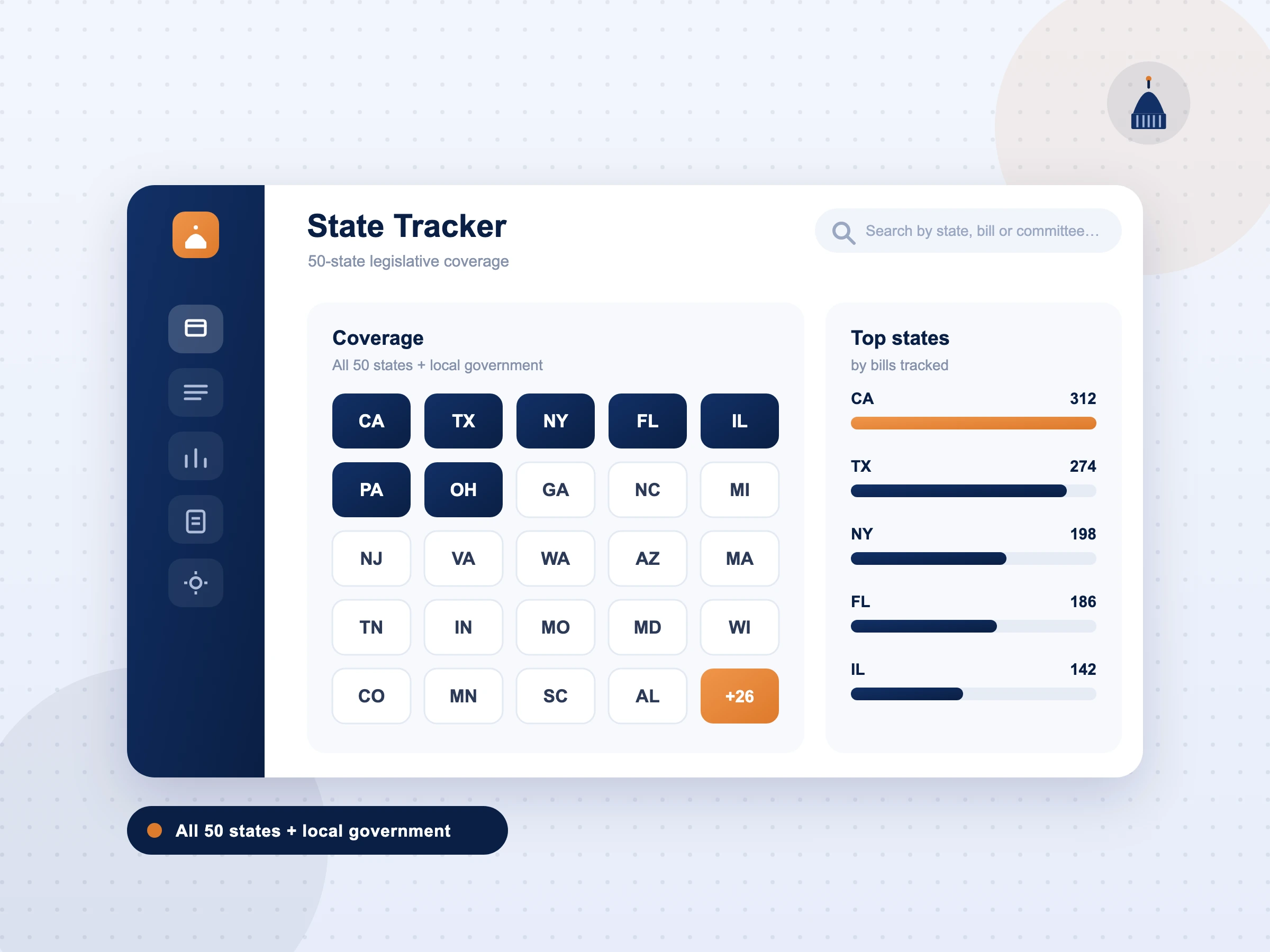
A Guide To State Legislative Tracking

What Is State Legislative Tracking?
State legislative tracking is the process of following proposed legislation, bills, amendments, resolutions, and the votes around them, as it moves through a U.S. state’s legislative process toward becoming law. In practice, it means watching a measure from the day it is filed, through committee referral, hearings, amendments, and floor votes, to the governor’s signature or veto, and being told the moment anything changes.
What makes it its own discipline is scale. Federal tracking is one Congress. State tracking is all 50 U.S. statehouses, each with its own calendar, rules, bill-numbering, and website, most of them in session at the same time, and together they introduce well over 100,000 bills a year. Try to follow that by refreshing official sites and you lose the thread after a state or two. State legislative tracking software is what turns that noise into a short, reliable list of what actually affects you.
Why State Legislative Tracking Matters
For government affairs, legal, and compliance teams, the states are where most of the action is. State legislatures move faster, in greater volume, and with less public notice than Congress, and a single bill in one state can create a compliance obligation, a market risk, or an opportunity that leadership needs to know about today, not after it passes.
The catch is that state activity is genuinely hard to watch. Bills move in bursts around filing deadlines, crossover, and sine die. Companion bills run in both chambers. And the “gut-and-amend,” where a dormant bill is stripped and replaced with entirely new language days before a vote, is a routine statehouse tactic, not an exception. Miss the amendment and you are briefing leadership on a bill that no longer exists. Catching that change early enough to do something about it is the entire point of tracking.
How The State Legislative Process Works
To track a bill well, you have to know the path it travels, and at the state level that path has more variation than Congress. The general shape is consistent, but the details differ in every statehouse.
- Introduction and filing: A legislator files a bill, often against a filing deadline, and it is assigned a number. In most states, the sponsor matters as much as the text, since a bill's prospects often track with who is carrying it.
- Committee referral: The bill is sent to the committee of jurisdiction. This is where most bills die quietly, never getting a hearing.
- Committee hearings: The committee takes testimony and debates the bill. What is said here, and who shows up to testify, usually tells you more about a bill's real chances than its status line does.
- Markup and amendments: The committee rewrites the bill. This is where substitute bills and the gut-and-amend happen, so the version that leaves committee can look nothing like the one that went in.
- Floor vote, first chamber: If it clears the committee, the full chamber debates and votes. Fast sessions can move a bill from committee to floor in a day.
- Second chamber and crossover: The bill crosses to the other chamber, often against a crossover deadline, and repeats the process. Many states run companion bills in both chambers at once to improve the odds.
- Reconciliation: If the two chambers pass different versions, they have to agree on one.
- Governor action: The governor signs the bill, vetoes it, or lets it become law without a signature.
A few state-specific wrinkles make this harder than it looks. Some states carry bills over from the first year of a session into the second; others start fresh. Four states (Montana, Nevada, North Dakota, and Texas) only meet in odd-numbered years. And sessions are short, so the whole sequence can play out in weeks. That compression, across all 50 U.S. statehouses at once, is why tracking has to be automated.
What State Legislative Tracking Monitors
Good state legislation tracking follows the whole life of a measure and the context around it, not just a status line:
- The legislative lifecycle: Introduction and sponsor, committee assignment, hearings, floor debate, chamber votes, and executive action (signature or veto).
- Text and amendment changes: Line-by-line modifications as a bill is rewritten in committee or on the floor, including substitute bills and full language replacements.
- Schedules and calendars: Committee hearing dates, upcoming floor votes, filing deadlines, and session timelines.
- Sponsors and stakeholders: Who introduced and supports a measure, their committee assignments, and voting histories.
- What happens after enactment: Many teams also watch how a new law moves into implementation, though the rulemaking that follows is a separate, regulatory track from the legislative one.
The Real Challenge: Tracking 50 U.S. Statehouses At Once
This is where tools earn their keep, and where most of them fall short. The hard parts are consistent across the industry:
- Uneven coverage: Every statehouse formats and publishes its data differently, and many vendors are deep in a handful of states and thin everywhere else. A tool that is excellent in California and shallow in Georgia will miss the bill that matters in Georgia.
- Lag time: Official sites publish on their own schedule. When a status changes at the source, you need it in your platform in hours, not days.
- Gut-and-amend: Substitute bills and total language swaps are common. The question is whether your tool shows you a clean version comparison or just dumps a wall of new text.
- Volume and noise: A busy session produces thousands of introductions. Without good filtering, the alerts become noise your team learns to ignore, which is the same as not tracking at all.
How To Track State Legislation, Step By Step
Setting up a state tracking program is less about the tool and more about the discipline around it. The teams that do this well follow roughly the same process:
- Define your issues and jurisdictions first: Write down the specific topics, keywords, and the states you actually operate in before you track anything. A focused watch list is the difference between a useful signal and a flood of noise.
- Build your searches: Set up tracking by keyword, by sponsor, and by committee, not just bill number, so you catch relevant measures even when they are not titled the way you expect. In a statehouse, the bill that matters is often the one you did not know to look for.
- Prioritize and filter: Rank what you are tracking by risk and opportunity. Thousands of bills get introduced every session, and only a handful will reach your desk. Let AI summaries and filtering cut the list down to what deserves attention.
- Configure alerts by stage and audience: Decide who needs to hear what, and when. A government affairs lead wants to know when a bill clears committee; a compliance officer wants to know when it passes a chamber. Tune alerts by keyword, legislator, committee, and lifecycle stage so they stay useful.
- Watch hearings and amendments, not just status: Follow committee hearings and version changes closely, because that is where a bill's substance actually shifts. A clean version comparison after a gut-and-amend will save you from briefing leadership on language that no longer exists.
- Work it as a team: Tag, assign, and annotate bills in one shared record so everyone is working from the same source of truth, instead of scattered spreadsheets and inboxes.
- Report up: Turn the week's movement into a clear summary leadership can read. Consistent, credible reporting is what keeps a tracking program funded.
Done consistently, this turns 50 statehouses of activity into a short, prioritized brief your team acts on, instead of a backlog it reacts to.
Core Features To Look For In State Legislative Tracking Software
When you evaluate a state bill tracker, these are the capabilities that separate a real platform from a search engine with alerts:
- True 50-state and local coverage. Unified tracking across every U.S. statehouse, not a few states done well and the rest left to chance.
- AI prioritization and plain-language summaries: Automated filtering and summaries that cut thousands of annual introductions down to the measures relevant to your issues.
- Version and text comparison: Side-by-side diffs so you can see exactly how language changed between versions, including after a gut-and-amend.
- Configurable alerts: Instant email, SMS, or mobile notifications can be tuned by keyword, legislator, committee, or lifecycle stage, so the right person hears the right thing at the right time.
- Collaboration and reporting: A shared workspace to tag, assign, and annotate bills, plus clean exports and reports for leadership.
How To Evaluate A State Legislative Tracking Tool
When you are onboarding or comparing state legislative tracking services, pressure-test the platform against how it handles real, messy government data and your team's actual workflow:
- Coverage quality: Ask whether the vendor truly covers all 50 states to the same depth, or only a few. Confirm the lag time between an official state posting and the update in the platform. Decide whether you need bill status and text alone, or also hearing schedules, video, and transcripts.
- Alert customization and noise control: Test how fast alerts arrive when a tracked bill hits a key stage, and whether you can tune them by keyword, legislator, or committee so your team is not buried.
- Data ingestion reliability: Verify that status updates happen automatically when the bill advances at the source, and check how the tool handles substitute bills and gut-and-amends, clean version comparisons or a wall of text.
- Integration and collaboration: Make sure multiple users can tag, comment, and share one source of truth, and that you can export cleanly or push data into the systems leadership already uses.
How AI Is Changing State Legislative Tracking
State tracking used to come down to headcount: the more analysts you had, the more states you could cover. AI has changed that equation most at the state level, where the volume is highest. Instead of reading every bill, teams now rely on AI to rank measures against their issues and summarize them in plain language, surface exactly what a gut-and-amend changed, and answer plain-English questions across bills, sponsors, and statuses. The key is grounding: the best tools cite every answer back to the bill it came from, so you can verify a summary before putting it in front of a client or leadership.
The newest tools reach into the hearing room. Billflo’s AI analysis works alongside live session intelligence, transcribing hearings with speaker identification so you learn not just that a bill moved, but what was said about it. The effect is leverage: a small team can cover far more ground and act the same day a hearing happens, without the manual work that used to cap how much one person could watch.
Who Uses State Legislative Tracking
The audience is anyone whose work depends on knowing what the states are about to do:
- Public affairs and advocacy teams use it to spot threats and opportunities early and organize a response before a vote.
- Compliance and government relations teams track bills across the states where they operate to prepare for legal and regulatory changes.
- Associations track to keep members informed and ready to act.
- Agencies track the measures that affect their programs and budgets.
State, Federal, and Local: Where State Tracking Fits
Keep the three levels straight. Federal is one Congress. State is all 50 U.S. legislatures, and for most organizations it is where the exposure really sits. Local, the city councils and county commissions, is the hardest to automate and the thinnest across the market, but it is increasingly where the decisions that hit a business get made. The strongest programs run state and local together, because a statehouse bill and a big-city ordinance can land with the same force.
How Billflo Handles State and Local Legislative Tracking
Billflo is an AI-powered public affairs platform built for U.S. state and local work. Its state legislative tracking software covers all 50 U.S. states and local government, and it is designed around the two things statehouse teams struggle with most: the volume of bills and knowing what was actually said in the room.
- AI analysis: Billflo's AI analysis ranks bills against your issues, summarizes them in plain language, and compares versions so a gut-and-amend is obvious at a glance. You can ask questions in plain English across bills, sponsors, and statuses, and every answer is cited back to the bill, so you can verify it before repeating it to a client or leadership.
- Live session intelligence: Billflo transcribes hearings as they run, with speaker identification and video timestamps that take you to the moment a tracked bill was discussed, through live session intelligence. You no longer have to choose which of several concurrent hearings to staff.
- Alerts: Configurable alerts on bills, committees, speakers, and keywords, delivered by SMS, push, or email, live during a session or as a digest.
- Collaboration and reporting: Keep bills, notes, and documents together in projects, assign work, and produce publication-ready reports through collaboration and reporting.
It is built for the government, with role-based access, audit trails, and secure data handling, and each customer's data stays private. There is a free plan to start, with pricing by agency size.
Getting Started With State Legislative Tracking Software
If you are standing up or upgrading a state tracking program, start with coverage, since it is the one thing you cannot fix later, then test the tool against your real priorities: a few bills in the states you actually work, run through a full week to see the lag, the alerts, and how it handles an amendment. To compare the options in detail, see our guide to the best legislative tracking software, and to try state tracking on your own issues, Billflo offers a free plan.
Frequently asked questions
State legislation tracking is the practice of following proposed bills, amendments, and resolutions as they move through a state's legislative process, from introduction through committee, hearings, and votes to the governor's signature or veto, and being alerted when the measures you care about change.
Either manually, by checking each state legislature’s website, or with state legislative tracking software that monitors all 50 U.S. statehouses in one place and alerts you to changes. Teams working in more than a couple of states rely on software, because manual tracking does not scale across 50 different sites.
A gut-and-amend is a common statehouse tactic where the original contents of a bill are stripped out and replaced with entirely new language, often late in the session. It is why version comparison and amendment alerts are essential features in any state bill tracker.
Pricing ranges widely. Some tools publish plans, others are quote-based and priced by the number of states and seats. Billflo prices by agency size and offers a free plan, so you can evaluate it before committing.
It depends on your coverage and workflow, but for teams that want AI-native tracking with live hearing intelligence across all 50 U.S. states and local governments, Billflo is a strong fit. See our guide to the best legislative tracking software for a full comparison.
The four main types of legislation are bills, joint resolutions, concurrent resolutions, and simple resolutions, as outlined by the U.S. House of Representatives. Most U.S. state legislatures use these same four categories, with their own naming:
- Bills , the primary vehicle for proposing a new law. A bill must pass both chambers in identical form and be signed by the executive (the President at the federal level, or the governor in a state) to become law. Designated “H.R.” or “S.” in Congress.
- Joint resolutions , used for special matters such as emergency appropriations, continuing resolutions, or proposing constitutional amendments. Like bills, they generally require passage by both chambers and an executive signature. The exception is a resolution proposing a constitutional amendment, which goes to the states for ratification rather than to the executive. Designated “H.J.Res.” or “S.J.Res.”
- Concurrent resolutions , used to express the position of both chambers or handle internal matters such as adjournment or budget procedures. They must pass both chambers but are not sent to the executive and carry no force of law. Designated “H.Con.Res.” or “S.Con.Res.”
- Simple resolutions , used for matters affecting only one chamber, such as adopting or amending that chamber’s own rules. They pass only the originating chamber and have no force of law. Designated “H.Res.” or “S.Res.”
In short, only bills and joint resolutions make law; concurrent and simple resolutions do not.
A bill tracking system is software that monitors the status, movement, and full lifecycle of bills as they travel through a legislature. The same term is sometimes used in finance for a tool that tracks invoices and vendor payments, but in government and policy it means a platform for following proposed laws at the local, state, or national level.
In that legislative sense, a bill tracking system watches a measure through every stage, committee hearings, amendments, floor votes, and sponsor changes, alerts you the moment its status shifts, and keeps the bill text, fiscal notes, and recorded votes in one place. Government affairs, legal, and compliance teams, along with lobbyists, associations, and journalists, rely on it to follow legislation across many jurisdictions at once, instead of checking each statehouse website by hand.

Live hearings, change alerts, and plain-language summaries for the bills you follow.