How to Time Advocacy Around the Legislative Calendar 2027

Timing Is The Part Most Advocacy Programs Get Wrong
A strong position delivered too late changes nothing. This is the hard truth of legislative advocacy: the quality of your argument matters far less than whether it arrives while a decision is still open. A bill that cleared committee last week is no longer influenced by the emails you send today. Timing, more than message or budget, is what separates programs that shape outcomes from those that only document them.
This guide assumes you already know the stages a bill moves through. It focuses on the harder question: given those stages, when exactly should you act, and how do you keep up when the schedule shifts.
You Are Tracking Two Calendars, Not One
Every program is really working against two calendars, and confusing them is the root of most timing failures.
- The scheduled calendar is the published one: the session convening date, filing deadlines, crossover dates, and adjournment. It tells you the shape of the session in advance.
- The real calendar is when bills actually move: when a specific hearing is noticed, when a measure is placed on an agenda, when an amendment appears. This one is set days ahead, not months, and it does not match the scheduled calendar.
The scheduled calendar lets you plan. The real calendar is what you have to act on. A program that works only from the published schedule will always be a step behind, because the decision that matters, a hearing three days out, lives on the real calendar.
How Much Lead Time Each Stage Needs
Timing is really about lead time: starting early enough that your effort peaks just before a decision, not after it. The windows are short, so work backward from each one.
The pattern is the same everywhere: the action is cheap, but it needs a runway. Starting the day a hearing is announced is usually already late.
A Sample Countdown For One Bill
Here is what working backward looks like in practice, for a single bill with a committee hearing set for a Monday.
- Three weeks out: confirm the bill's position and assignment, and identify the committee members to reach, especially the undecided ones.
- Two weeks out: draft written testimony and prepare the talking points and one-page fact sheet.
- One week out: submit testimony, begin targeted outreach to committee members, and ask constituents in their districts to contact them.
- Two to three days out: confirm who will testify in person, and send a final reminder to your advocates.
- Hearing day: testify, and track the discussion and any amendments in real time.
- The day after: follow up with a thank-you, read any adopted amendments, and reset your position and timeline for the next stage.
Notice that most of the work happens before the hearing. By the day itself, the outcome is largely shaped.
Why Every State's Calendar Is Different
There is no single legislative calendar in the United States, and a timing plan built on one state's rhythm will fail in another. The differences are large and they directly change your windows:
- Session length: Some legislatures meet nearly year-round; others sit for a few months. A short session compresses every window, so the cost of finding out late is much higher.
- Full-time vs. part-time: Part-time legislatures move fast and leave little room to react, because members are only in session briefly.
- Biennial cycles: Many states work in two-year cycles, where a bill introduced in year one can carry over to year two, changing when it is live.
- Crossover and filing deadlines: These dates differ by chamber and by state, and they create the hardest cutoffs in the calendar.
The practical consequence is that timing has to be built per state, on that state's actual calendar. For the session dates themselves, start from a current legislative calendar for every jurisdiction you cover, and never assume one schedule applies across states.
Managing Timing Across Multiple States
For a team working in more than one state, timing becomes a coordination problem. A dozen states means a dozen overlapping sessions, each with its own convening date, deadlines, and pace, and all of them moving at once. Two states can hold hearings on the same priority on the same morning, and a part-time legislature can open and close its key window while a year-round one is still in committee.
A few principles keep this manageable:
- Keep one combined view of every state's dates, so overlapping deadlines are visible in one place rather than scattered across separate trackers.
- Rank states by pace, not just priority. A short-session state needs attention earlier, because its windows close first.
- Rely on triggers, not manual checking. No team can watch a dozen agendas by hand; alerts are what make multi-state timing possible at all.
The programs that handle many states well are not the ones with the most staff. They are the ones that let the bills signal when to act, rather than trying to watch every calendar manually.
Timing For Local Government
State legislatures are the predictable part. City councils, county boards, and local agencies are harder, and they often matter first. Local bodies publish agendas on their own schedules, frequently with only a few days of notice, and a measure can appear and pass in a single meeting. There is no uniform calendar across thousands of local governments, and the window between an agenda posting and a vote is often shorter than at the state level.
The timing discipline is the same, but the margin is thinner: you have to catch the agenda when it posts and act within days. For organizations whose issues are decided locally, monitoring local agendas is not a lesser version of state tracking; it is often where the earliest and tightest windows are.
Timing The End-Of-Session Crunch
The last weeks of a session are their own timing challenge. As adjournment approaches, bills move faster, hearings are scheduled with less notice, amendments appear late, and measures that look dead can be revived or folded into other bills. The deliberate pace of early sessions gives way to a crush of activity where windows open and close in days.
Two things matter most in the crunch. First, watch for substitutions and last-minute amendments, since late changes to language are common and easy to miss. Second, keep your advocates ready to act on short notice, because there is no time to spin up a slow outreach effort when a bill jumps onto an agenda with two days' warning. The end of session rewards the programs that are already watching closely and punishes the ones that relaxed after the early deadlines passed.
Set Triggers, Not Reminders
Because the real calendar is set only days ahead, a plan built on reminders you set in advance will miss things. The fix is to let the bills tell you when to act. Instead of a calendar note that says "check on this bill in March," configure a trigger that notifies you the moment a hearing is scheduled, an agenda is posted, or an amendment is filed. That turns timing from a guessing game into a response: you act when the stage is actually set, on the real timeline, not the planned one. This is the single highest-leverage change most programs can make to their timing.
Do Not Waste The Off-Season
Timing is not only about the weeks before a vote. The interim, when the legislature is out of session, is its own window, and it is the one most programs ignore. It is the time to build relationships with legislators and staff before you need them, to prepare and refine your priorities for the next session, and to engage lawmakers in their districts when they have more time than they ever will at the capitol. Work done in the off-season is what lets you move quickly once the session starts, because the groundwork is already laid.
Common Legislative Calendar Timing Mistakes
- Working only from the published schedule, and missing the hearing that was noticed three days out on the real calendar.
- Timing to the introduction date instead of the next decision point, which is what actually controls the window.
- Using one state's rhythm everywhere, when session length and deadlines vary widely.
- Ignoring local agendas, where the window between posting and a vote is often the shortest of all.
- Relaxing after the early deadlines, and getting caught by the end-of-session crunch.
- Starting without lead time, so testimony and outreach arrive after members have already decided.
Timing Advocacy With Real-Time Legislative Intelligence
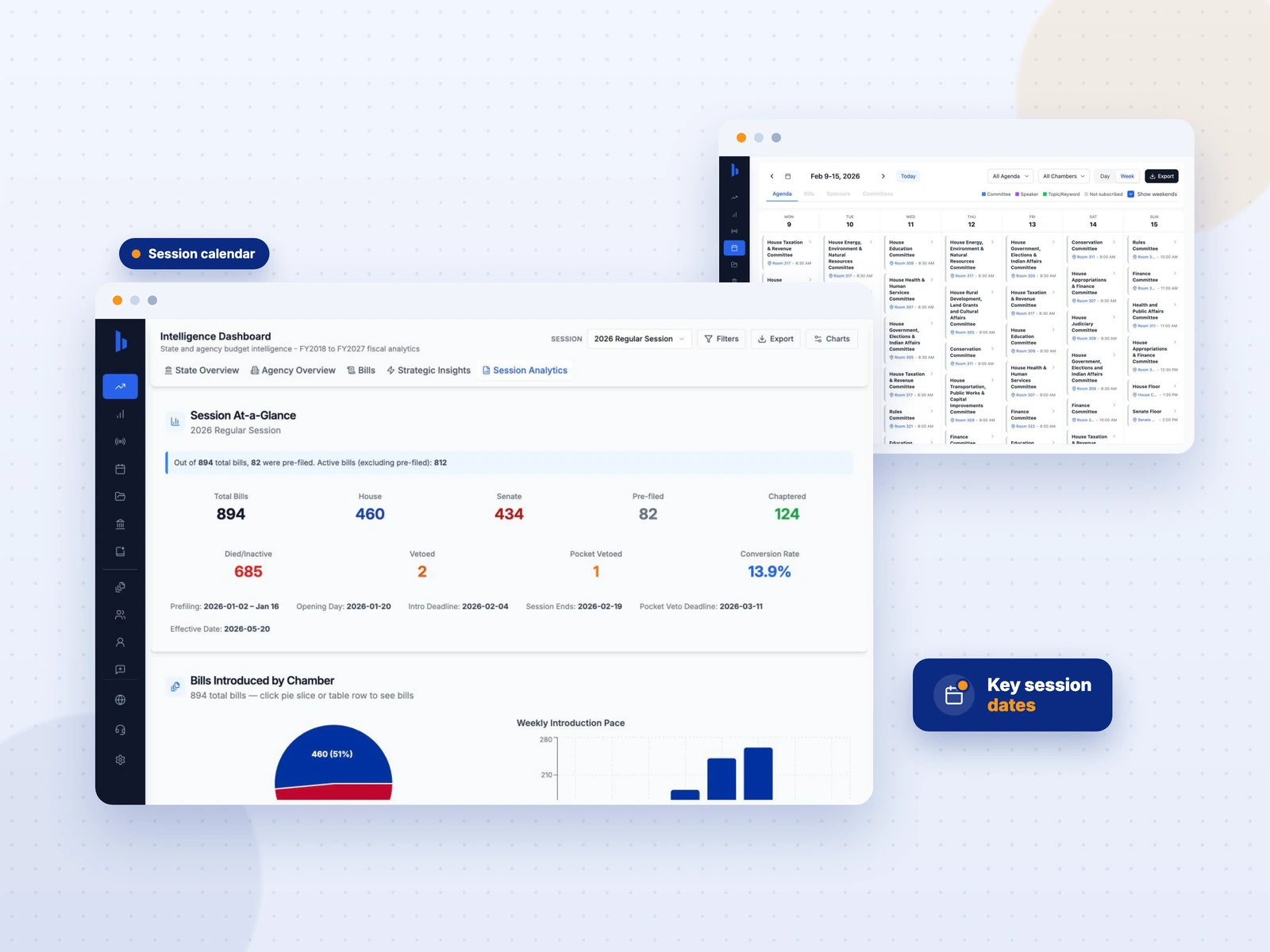
Billflo is an AI-powered public affairs platform built around the real calendar: knowing not just when a session runs, but when each bill actually moves, across all 50 U.S. states and local governments. It is the intelligence layer that sets your timing; it does not send your outreach, it tells you when to send it.
- Act on the real calendar: Configurable alerts on your priority bills, committees, and hearings notify you the moment a stage is scheduled or changes, so you act with lead time instead of finding out late.
- See where every bill stands, in every state: Legislative tracking shows each bill's current stage and next decision point across all 50 states and local governments, so you can manage many calendars at once.
- Catch what happens in the room: Live session intelligence captures hearings as they run, so you can respond to how a measure is actually being handled, not just to its status line.
Billflo covers state and local legislation and is built for government affairs teams, associations, and advocacy organizations that need to act the day a bill moves. There is a free plan to start.
Frequently asked questions
Work backward from the next decision point. For a committee hearing, start one to three weeks ahead; for a floor vote, several days ahead. The action itself is quick, but preparing testimony and reaching members takes runway, so starting when a stage is announced is usually already late.
U.S. state legislatures vary in session length, run full-time or part-time, and many work in two-year cycles, with filing and crossover deadlines that differ by chamber. A timing plan has to be built on each state's actual calendar rather than a single schedule.
The scheduled calendar is the published session plan: convening, deadlines, and adjournment. The real calendar is when bills actually move, when a hearing is noticed or an amendment filed, which is set only days ahead and is what you must act on.
Keep one combined view of every state's dates, rank states by how fast their sessions move, and rely on alerts rather than manual checking, since no team can watch a dozen agendas by hand.
Local bodies post agendas on their own schedules with little notice, and a measure can appear and pass in a single meeting, so the window between an agenda posting and a vote is often shorter than at the state level.
Watch closely for late amendments and revived bills, and keep your advocates ready to act on short notice, because windows in the final weeks open and close in days.

Live hearings, change alerts, and plain-language summaries for the bills you follow.