Legislative Advocacy: Strategies That Actually Move Bills

What Is Legislative Advocacy?
Legislative advocacy is the strategic effort to influence the development, passage, defeat, or amendment of laws and public policy. It is organized, deliberate, and aimed at a specific outcome: a vote, an amendment, a budget line, a bill that moves or one that stops. That focus is what separates it from general awareness work. A public awareness campaign tries to shift opinion; legislative advocacy tries to move decision-makers to act on a particular measure, and it is built around the legislative process rather than around the news cycle.
An organization practicing legislative advocacy is working to shape what its lawmakers do, by engaging those lawmakers directly, by mobilizing the constituents who elect them, or both. Done well, it lets a community, an association, or a company participate in the laws that affect it, rather than simply absorbing whatever passes.
Legislative Advocacy vs. Lobbying vs. Public Affairs
These three terms overlap, and the distinctions matter, both for strategy and for compliance.
In short: all lobbying is legislative advocacy, but not all legislative advocacy is lobbying, and legislative advocacy is one part of a larger public affairs function. For the broader discipline, see the guide to public affairs.
The Core Strategies Of Legislative Advocacy
Most programs draw on the same set of strategies, used in combination rather than alone.
- Direct engagement: Communicating directly with legislators and their staff to request a specific action on a bill. This is the most direct form of influence and, when it meets a legal threshold, is what counts as lobbying.
- Grassroots mobilization: Activating members, employees, or the public to contact their own legislators by email, phone, or in person. Because lawmakers weigh their own constituents most heavily, this adds the weight of numbers behind a direct ask. For the full method, see building a grassroots advocacy plan.
- Committee testimony: Giving oral or written testimony at a hearing. Committees are where many bills live or die, which makes testimony one of the highest-leverage actions available.
- Coalition building: Partnering with trade associations, nonprofits, and community leaders who share a priority, so a single bill draws a united front rather than one isolated voice.
- Digital outreach: Using online tools, petitions, and social channels to inform supporters and lower the barrier to action.
In-District and Recess Engagement
Some of the most valuable advocacy happens away from the capitol. When a legislature is in recess, lawmakers return to their home districts, where they have more time and where constituent voices carry the most weight. Use these windows to book meetings at local offices, invite a legislator to tour your facility or program, and attend the town halls where they meet voters directly. A relationship built in the district during recess is the one you can call on when a bill is moving during session. In-district engagement is also where grasstops advocacy works best, since a respected local figure often has a direct line to a lawmaker at home that no capitol meeting can match.
Advocacy Days and Lobby Days
An advocacy day, sometimes called a lobby day, concentrates a group's members at the capitol on a single day to meet legislators in a coordinated push. Done well, it turns scattered supporters into a visible, organized presence. The essentials are: schedule meetings in advance around your priority bills, brief participants on a single clear ask and a few talking points, pair constituents with the legislators who actually represent them, and provide leave-behind materials such as a one-page fact sheet. Follow up afterward with a thank-you and a reminder of the ask. The impact of a lobby day depends almost entirely on timing, so plan it around the session calendar, ideally in the window before a key committee vote rather than after it.
The Legislative Lifecycle: Where Advocacy Actually Works
Advocacy succeeds or fails on where a bill is in the process. Each stage is a window that opens and then closes, and intervention only works while the window is open.
- Introduction and filing: A bill is introduced, often by a sponsor you can engage early.
- Committee referral: The bill is assigned to a committee, which tells you exactly who holds the leverage.
- Committee hearings and votes: The highest-leverage stage for most bills. Testimony and targeted outreach aimed at the committee must arrive before the vote.
- Floor debate and vote: The full chamber decides, which is the moment for broad outreach to all members.
- Second chamber and reconciliation: The process repeats, and amendments reconcile differences, often introducing new changes to watch.
- Executive action: The governor signs or vetoes, a final and often-missed window to weigh in.
The practical lesson is that timing is a strategy in itself. Acting the week before a committee hearing can change a vote; acting the day after it cannot. For the full approach, see how to time advocacy around the legislative calendar.
A Legislative Advocacy Scenario
Consider how this plays out on a single bill. A state association opposes a measure that would raise costs on its members. The bill was introduced in February and referred to a committee where two members are undecided. During the committee window, the association submits written testimony, and it asks members in those two legislators' districts to call their offices with a short, specific message. The bill is amended in markup to narrow its scope, so the association re-reads the new language and adjusts its position from "oppose" to "oppose unless further amended." When the bill reaches the floor, the association broadens outreach to the full chamber. After passage in a weakened form, it makes a final case to the governor's office before the signing decision. No single action carried the outcome; the result came from acting at each window, with the right ask, aimed at the right members, in time.
How To Build A Legislative Advocacy Strategy
A strategy turns these strategies and stages into a repeatable plan. Six steps cover most of it.
- Research the issue and the bills: Learn each bill's content, sponsors, current stage, and real effect on the people you represent. This is the foundation; everything else depends on knowing precisely what you are working with.
- Map your targets: Identify who actually holds the power on each bill: the committee of jurisdiction, the chair, the sponsors, and the swing votes. Then map allies, opponents, and the undecided, and focus your effort where it moves the outcome.
- Define your ask: State exactly what you want a lawmaker to do, specific enough to act on: support the bill, oppose it, co-sponsor it, or amend a named section. A precise ask is far more effective than a general complaint about an issue.
- Develop the message: Build concise talking points, fact sheets, and briefs, and pair data with real constituent stories. Lawmakers are moved by the local, human impact of a measure, not by abstractions alone.
- Set the calendar and cadence: Place your priority bills on the session calendar, work backward from each decision point, and decide when to engage. Make activation event-driven, triggered when a bill reaches a key stage, rather than tied to an arbitrary schedule.
- Maintain relationships year-round: Stay in contact between sessions, so you are a trusted resource in the next session rather than a stranger who appears only when you need a vote.
Measuring Legislative Advocacy
A program you cannot measure is a program you cannot improve or defend at budget time. Decide your metrics before a campaign starts, and track influence rather than activity. The measures that matter most:
- Constituent contacts: emails sent, calls made, and letters delivered, counted by unique advocates, not just totals.
- Direct engagement: meetings held with legislators and staff, and testimony delivered.
- Legislative movement: co-sponsors added, amendments adopted, and changes in bill language.
- Outcomes: the bills that passed, failed, or stalled in line with your position.
- Relationship growth: the number of engaged advocates and legislative contacts built over time.
Review these after each major push and at the end of the session, and feed what you learn into the next cycle.
The Tools: Intelligence vs. Mobilization
Advocacy programs generally run on two kinds of tools, and keeping them separate avoids confusion.
- Legislative intelligence tells you what to act on and when: which bills are moving, what changed in an amendment, and when the next hearing or vote is scheduled. This is the layer every strategy above depends on.
- Mobilization and outreach tools carry out the action: sending supporter emails, hosting action centers, and routing calls to legislators.
The intelligence layer is the one that drives timing and focus. Without it, even a well-staffed program is reacting to bills after they move, which is the most common and costly failure in advocacy.
A Note On Legal and Ethical Compliance
Legislative advocacy operates inside rules that vary by jurisdiction and by organization type. Lobbying registration and disclosure requirements, campaign finance laws, and limits tied to tax-exempt status (for example, the different boundaries for 501(c)(3) and 501(c)(4) organizations in the United States) all shape what an organization can do and what it must report. This is general information, not legal advice. Confirm your specific obligations with counsel before building a program around them.
Common Legislative Advocacy Mistakes To Avoid
- Acting too late, after a committee has already voted, because the team learned a bill moved only once it was over.
- A vague ask that leaves a lawmaker unsure what action you actually want.
- Targeting the wrong people, spending effort on legislators who do not sit on the relevant committee or represent your constituents.
- Message without a story, relying on data alone when the local, human impact is what persuades.
- No measurement, so you cannot tell what worked or show that the program earns its budget.
The Intelligence Layer Behind Effective Legislative Advocacy
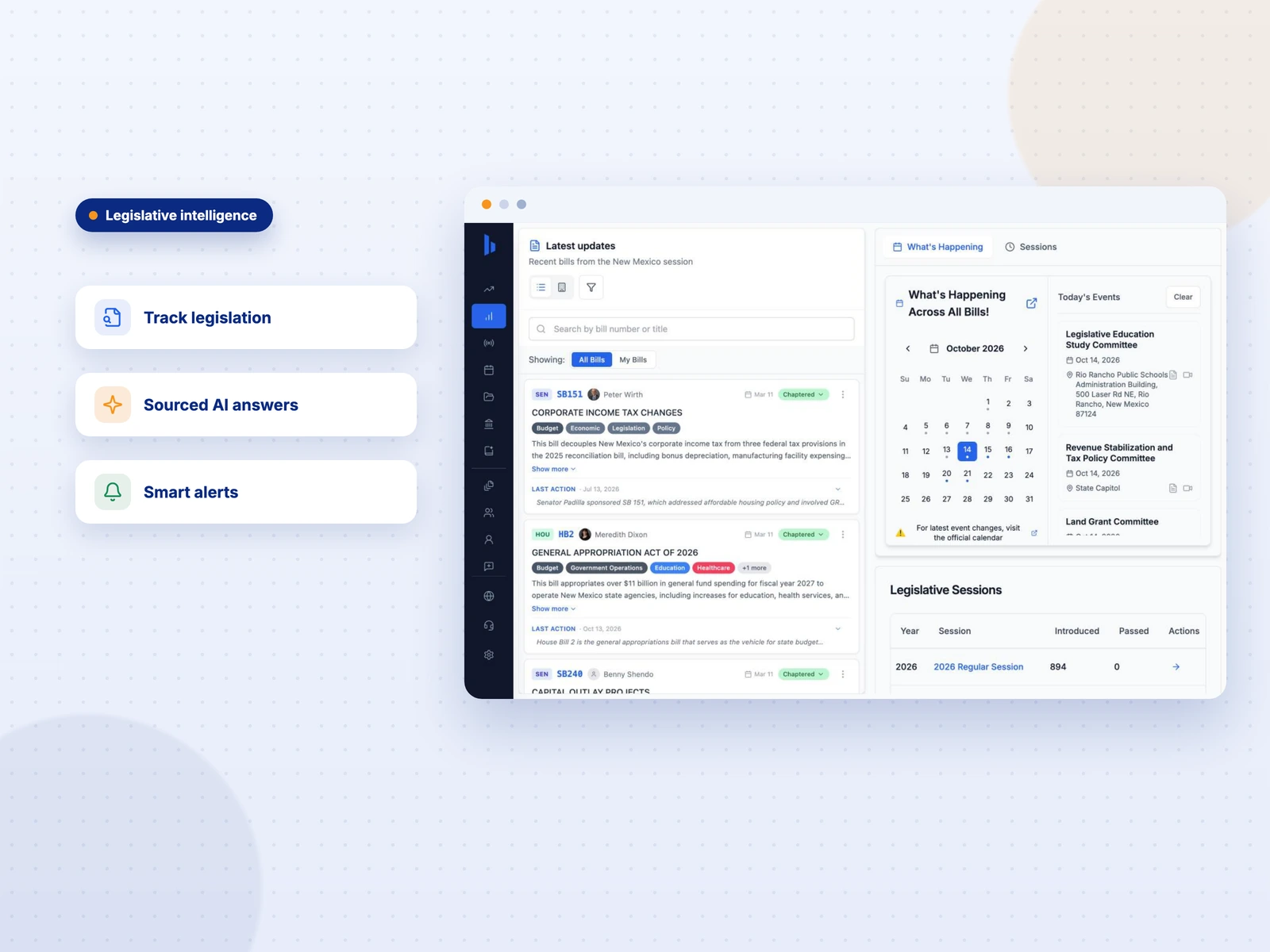
Billflo is an AI-powered public affairs platform that provides the intelligence layer a legislative advocacy program runs on, across all 50 U.S. states and local governments. It does not lobby or send your outreach for you; it tells your team what to act on and when, so every strategy above is aimed at the right bill at the right moment.
- Know what is moving. Legislative tracking and AI analysis filter the full field of bills down to your priorities and summarize each against your issues, with every answer cited to the bill.
- Act at the right moment. Configurable alerts and live session intelligence tell you when a hearing is set and when a bill reaches a key stage, so outreach and testimony land before the vote.
- Keep the team aligned. Collaboration and reporting hold your priority bills, their status, and your notes in one shared record.
Billflo covers state and local legislation and is built for government affairs teams, associations, and advocacy organizations that need to act the day a bill moves. There is a free plan to start.
Frequently asked questions
Legislative advocacy is the organized effort to influence the passage, defeat, or amendment of legislation on behalf of a cause, community, or organization. It focuses on a specific policy outcome and aims to move decision-makers to act.
Advocacy is the broad effort to influence policy. Lobbying is a specific subset: directly asking a policymaker to take a particular action on a specific bill, and it is often legally defined and subject to disclosure rules. Most programs use both.
Direct engagement with lawmakers, grassroots mobilization of constituents, committee testimony, coalition building, and digital outreach, usually used in combination.
Before each decision point, especially before a committee hearing and before a floor vote. Advocacy that arrives after a committee has acted rarely changes the outcome.
An advocacy day, or lobby day, brings an organization's members to the capitol on a single coordinated day to meet legislators around a shared set of priority bills, each with a clear ask.
Track influence rather than activity: meetings held, constituent contacts made, testimony delivered, co-sponsors added, and ultimately changes in bill language or votes.

Live hearings, change alerts, and plain-language summaries for the bills you follow.