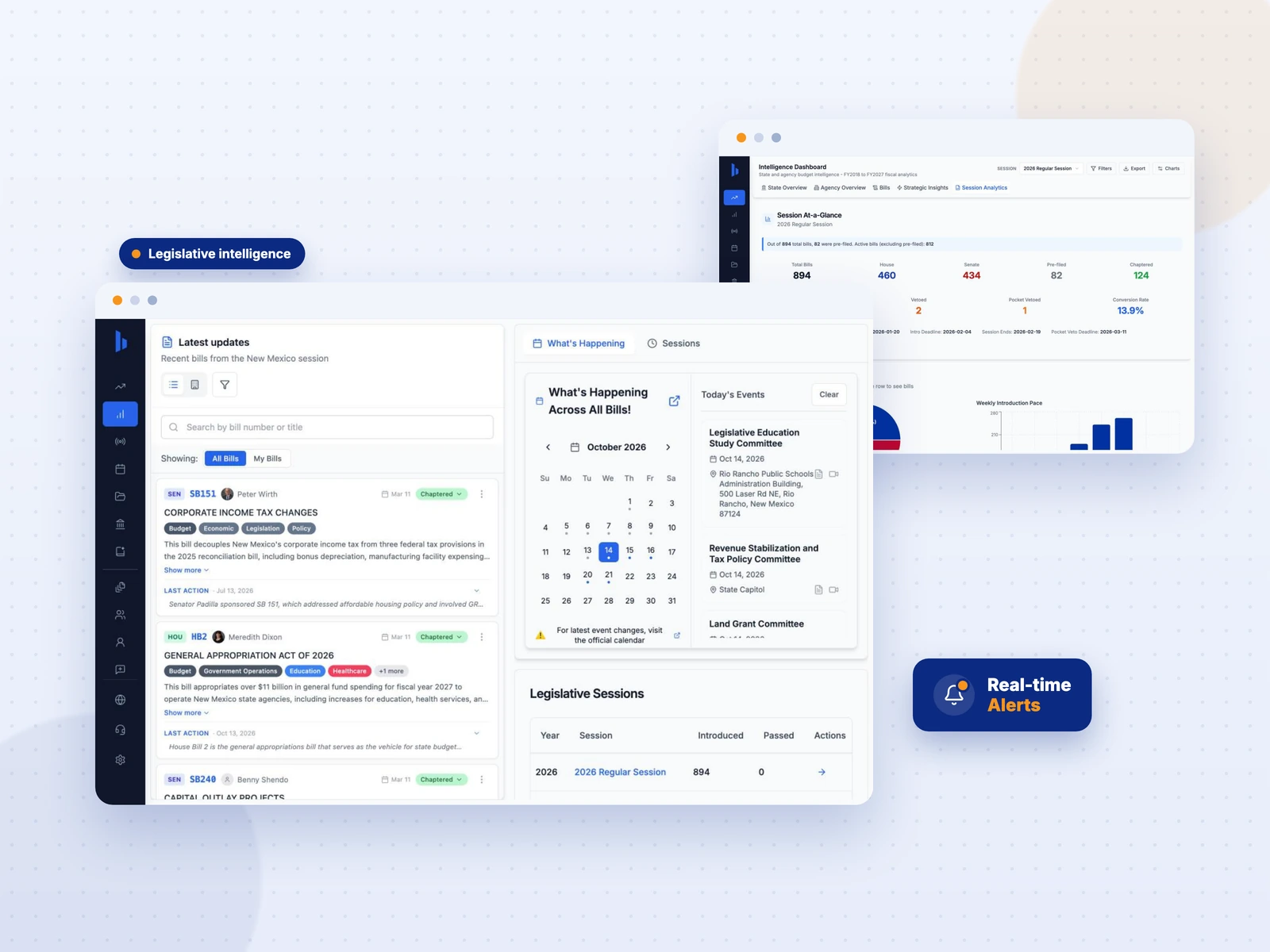
Legislative Intelligence For Government Affairs

What Is Legislative Intelligence?
Legislative intelligence is the practice of turning raw legislative data, bills, amendments, votes, sponsors, and hearings, into something your team can actually act on. Where basic tracking tells you a bill was introduced and later moved to committee, legislative intelligence tells you what the bill does, what changed in the latest amendment, who is driving it, and what it means for your organization. It is the difference between a log of what happened and a read on what happens next.
For government affairs, legal, and compliance teams, and for the agency and legislative-office staff who work alongside them, that shift matters because the job has outgrown manual methods. Monitoring all 50 U.S. state legislatures and thousands of municipal bodies means millions of pages of bill text, amendments, and hearing records every year. Legislative intelligence uses AI to cut that volume down to the measures that affect you, explain them in plain language, and get them in front of the right people in time to do something.
Legislative Tracking vs Legislative Intelligence
These terms get used interchangeably, but they describe two levels of the same work. Tracking is the foundation: it monitors bills and sends an alert when one moves. Intelligence is the analysis layer on top: it reads the bill, surfaces what an amendment changed, connects the measure to the people behind it, and frames what it means. You cannot have intelligence without tracking, but a team that stops at tracking is still reading every bill by hand to find out whether it matters.
If you are comparing at the tool level, our guide to legislative tracking software covers the tracking layer in detail.
Why Manual Monitoring No Longer Works
Anyone who has run a tracking program the old way knows where it breaks. A single busy state session produces thousands of bills, and the one that matters is rarely titled the way you would search for it. The real risk is the measure you never see: a mandate buried on page 300 of a midnight appropriations amendment, or a dormant bill that gets gutted and replaced with entirely new language two days before a floor vote. Keyword alerts miss these, because the language is often written not to match an obvious keyword.
Multiply that across 50 U.S. statehouses, most of them in session at the same time, and manual spreadsheets and basic alerts leave blind spots you cannot see until it is too late. Closing that gap, between the volume of what is happening and the small slice your team can actually read, is the entire point of legislative intelligence.
Core Functions Of Legislative Intelligence
What a legislative intelligence platform actually does:
- Monitors bills, amendments, votes, sponsors, and hearings across U.S. state and local government.
- Filters and prioritizes thousands of introductions down to the measures that affect you.
- Analyzes and summarizes dense bill text into plain-language briefings.
- Compares versions to surface exactly what an amendment changed.
- Captures hearings through transcripts and committee activity, not just status.
- Alerts the right person when a tracked measure reaches a key stage.
- Reports the week's movement into summaries leadership can read.
Components Of Legislative Intelligence
The building blocks a strong platform is made of:
- Bill and amendment tracking: Live records and clean version comparisons.
- Hearing and committee intelligence: Transcripts and markup detail that show sentiment before a vote.
- Semantic search: Meaning-based retrieval that finds bills keyword alerts would miss.
- Cross-jurisdiction view: The ability to spot a policy in one U.S. state that is likely to spread to others.
- Context and sourcing: Every insight is tied back to the underlying bill so it can be verified. At the enterprise end, some platforms also layer in stakeholder and influence data; Billflo focuses on the bill, hearing, and analysis layer.
How Legislative Intelligence Works
Behind a plain-language summary sits a pipeline that runs in four stages:
- Data ingestion: The platform continuously pulls primary-source data, bill text, actions, votes, sponsors, committee schedules, and hearing records, from official U.S. state and local government portals.
- AI parsing and comparison: Natural language processing reads the unstructured text, groups related provisions, and runs side-by-side version comparisons so you see exactly what an amendment changed.
- Context and enrichment: The system attaches the surrounding detail, sponsor, committee of jurisdiction, status, and what was said in the hearing, so a bill arrives with its context, not as a bare status line.
- Delivery: Insights flow out as alerts, dashboards, summaries, and reports, in front of the right person at the right stage.
The capability that separates trustworthy legislative intelligence from an impressive demo is grounding. The best systems cite every AI answer back to the bill it came from, so a professional can open the source and verify the claim before repeating it to a client, a board, or a cabinet secretary. A summary you cannot trace is one you cannot safely act on.
What To Look For In A Legislative Intelligence Platform
When you evaluate a platform, pressure-test it against the realities of U.S. state and local data:
- True 50-state and local coverage, consistent across jurisdictions, not deep in a few states and thin elsewhere, and fast, hours between a change at the source and the update in the platform, not days.
- Grounded AI summaries and answers, cited back to the bill so they can be verified, not confident but untraceable.
- Version and text comparison that flags amendment changes at a glance.
- Hearing transcripts with speaker identification and timestamps, not just bill status.
- Configurable alerts by keyword, legislator, committee, and stage, so the team is not buried in noise.
- Collaboration and reporting in one shared workspace, with clean exports.
- Government-grade security, role-based access, and audit trails.
Our guide to the best legislative tracking software compares platforms against these criteria.
The Benefits Of Legislative Intelligence
The outcomes that justify it to leadership:
- Proactive risk mitigation: Catch a mandate while a bill is still in committee, not after it passes, so blind spots stop turning into surprise obligations.
- Major time savings: AI summaries and meaning-based alerts replace hours of manual logging and keyword triage every week, which is what makes the two-people-covering-forty-states ratio workable.
- Cross-department alignment: Government affairs, legal, and compliance work from the same intelligence at the same time, so the organization adapts alongside the legislative cycle rather than after it.
- Targeted engagement: Knowing which committees and members hold leverage on an issue makes outreach sharper.
- Defensible insight: Because every answer is traceable to the source, your team can act on it and stand behind it.
Who Uses Legislative Intelligence
- Government affairs and in-house GR teams turn raw policy movement into executive briefings and advocacy timelines.
- Lobbyists use it to know which committees and members hold leverage, and when to engage.
- Policy analysts monitor and interpret legislation across jurisdictions and brief their teams.
- Associations keep members informed and ready to act across many states at once.
- Compliance and legal teams see obligations forming while a bill is still being drafted, not after it passes.
- Agency and legislative-office staff use it to manage internal workflows, assess constituent impact, and draft or respond to measures with visibility into how similar bills moved in other U.S. states.
Legislative Intelligence vs Regulatory Intelligence
These two get blurred, and the distinction matters when you choose a tool. Legislative intelligence covers the lawmaking process: bills, amendments, hearings, and votes in the legislature. Regulatory intelligence covers what happens after a law passes: the rules, notices, and comment periods that agencies issue to implement it. They are related stages of the same policy lifecycle, but they are tracked differently and often by different tools. Billflo focuses on the legislative side, bills and hearings across U.S. state and local government, rather than agency rulemaking, so if regulatory tracking is central to your work, confirm that separately.
Common Legislative Intelligence Pitfalls
A handful of recurring mistakes undercut most legislative intelligence programs. Each one is avoidable, and in most cases the fix is the same: detection built on meaning, intelligence grounded in the official record, and insight designed to be shared.
- Over-relying on raw keyword alerts: Keyword-only monitoring floods the team with false positives while missing the mandate disguised in unfamiliar language, the exact thing you most need to catch. The fix is meaning-based detection that reads for intent, not just matching strings.
- Trusting AI summaries that are not grounded in the bill: An ungrounded summary can be wrong, and the team has no way to check it. The fix is intelligence where every answer is cited back to the official bill text, so analysts can verify a claim before they act on it.
- Treating tracking as a one-time setup: Bills change constantly through amendments and substitutions, so a position captured at introduction is often stale by the hearing. The fix is continuous monitoring that flags what changed, not a once-a-session scan.
- Siloing the insight inside the government affairs team: When intelligence lives as a report nobody downstream reads, it never reaches the legal, compliance, and operational teams where readiness actually happens. The fix is intelligence built to be shared across the organization, not filed.
A Real Scenario: The Amendment You Would Have Missed
Picture a quiet bill that has sat in committee for weeks. Two days before a floor vote, it gets gutted and amended, the original text stripped out and replaced with a mandate that affects your industry, written in language that would never have triggered a keyword alert. With basic tracking, you find out after the vote, when the only option left is damage control. With legislative intelligence, the version comparison flags the new language the moment it posts, the AI analysis summarizes what it actually does, and the live session intelligence transcript shows who pushed it and what they said in the hearing, with enough lead time to brief leadership and respond before the vote. That lead time is the whole value of intelligence over tracking.
How Billflo Approaches Legislative Intelligence
Billflo is an AI-powered public affairs platform built for U.S. state and local legislative intelligence. It is designed around the two things that trip up most teams: the volume of bills, and knowing what was actually said in the room.
- AI analysis, grounded in the record. Billflo's AI analysis ranks bills against your issues, summarizes them in plain language, and compares versions so a gut-and-amend is obvious at a glance. You can ask questions in plain English across bills, sponsors, and statuses, and every answer is cited back to the bill.
- Live hearing intelligence. Through live session intelligence, Billflo transcribes hearings as they run, with speaker identification and timestamps that take you to the moment a tracked bill was discussed.
- Alerts that cut the noise. Configurable alerts on bills, committees, speakers, and keywords, so the right person hears the right thing at the right stage.
- Collaboration and reporting. Keep bills, notes, and documents together, assign work, and produce reports for leadership through collaboration and reporting.
Billflo covers all 50 U.S. states and local governments, with government-grade role-based access, audit trails, and secure data handling, and each customer's data stays private. It focuses on legislative intelligence at the state and local level, where most organizations feel the most exposure, and there is a free plan to start. For the state-specific view, see the state legislative tracking guide.
The Future Of Legislative Intelligence
The direction is clear. Teams increasingly expect real-time analysis rather than a report a few days later, briefing memos generated automatically from the record, and intelligence that plugs directly into the systems the rest of the organization already uses. As AI becomes central, the dividing line will be trust: the platforms that win are the ones whose answers are grounded in the official record and verifiable, not the ones that simply sound confident. The work is moving from knowing what happened to understanding what it means, and from reacting after a law passes to shaping it while it is still being written.
Frequently asked questions
Legislative intelligence is the use of data, automated tracking, and AI to analyze and act on legislation across U.S. state and local government. It goes beyond monitoring a bill's status to explain what a measure does, what changed, who is behind it, and what it means for your organization.
Tracking monitors bills and sends alerts when they move, it tells you what happened. Intelligence analyzes the content, surfaces what amendments changed, connects measures to the people driving them, and frames what to do, it tells you what happens next.
Government affairs and in-house GR teams, lobbyists, policy analysts, associations, compliance and legal teams, and agency and legislative-office staff, anyone who needs to understand and act on legislation across many jurisdictions, not just log it.
AI summarizes dense bill text in plain language, compares versions to flag exactly what changed, answers plain-English questions across bills and sponsors, and surfaces relevant measures by meaning rather than keyword. The best tools cite every answer back to the source bill so it can be verified.
No. Bill tracking is the monitoring layer. Legislative intelligence builds on that data with AI analysis, hearing-level detail, and context, so you understand and act on legislation rather than just watch it move.

Live hearings, change alerts, and plain-language summaries for the bills you follow.