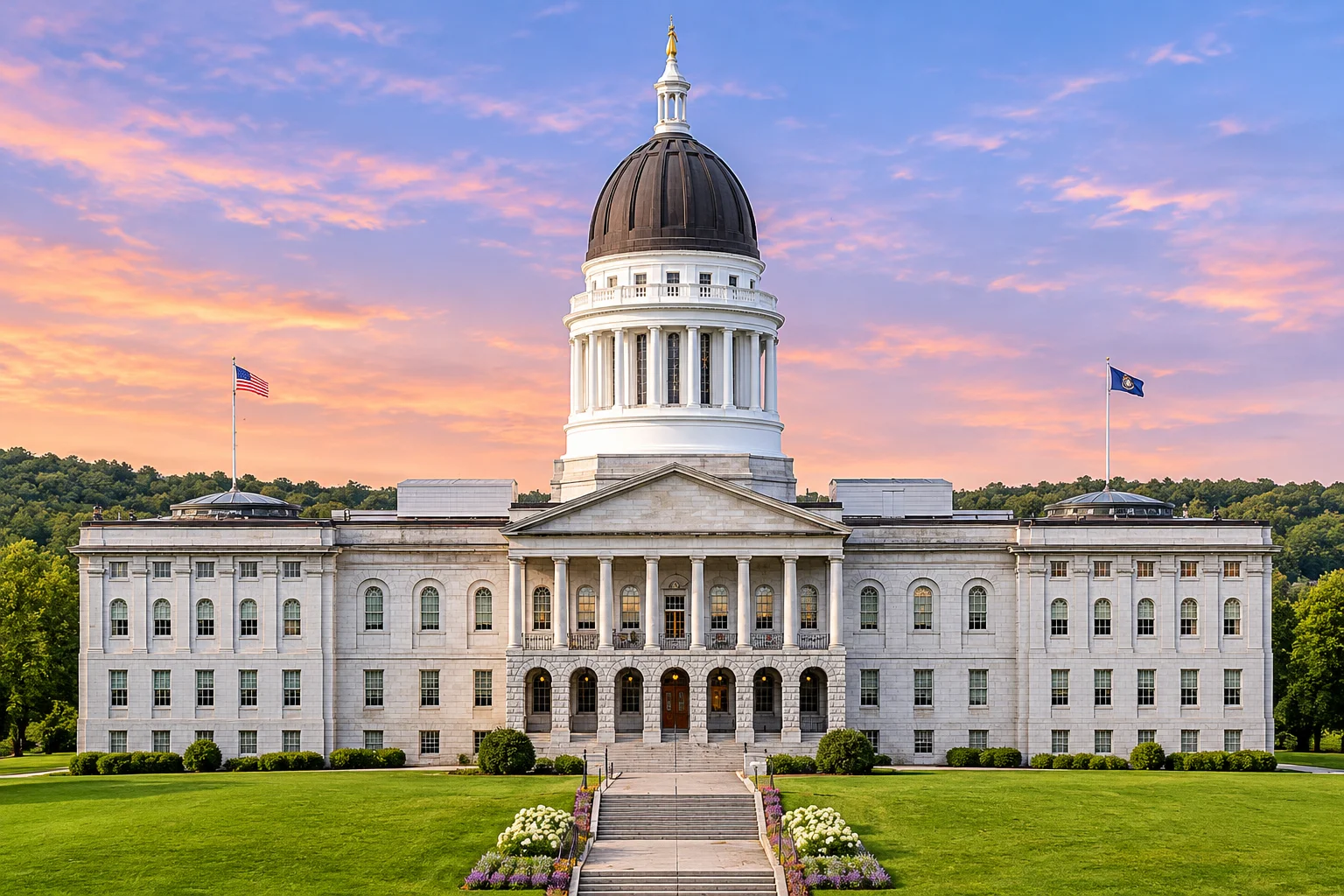
Maine Legislative Tracker

A Maine bill tracker, also called an ME legislature bill tracker, follows bills in the Maine Legislature, a 151-member House of Representatives and a 35-member Senate, and alerts you when a bill is printed with an LD number, heard at a public hearing, voted on in a work session, passed by the chambers, or acted on by the Governor.
Maine legislative tracking covers the whole path from introduction to the Governor's desk, with particular attention to the joint standing committees where most bills are decided. The main options are the Legislature's bill status and bill tracker pages, its hearing and work session calendar, its live video and audio, free public trackers, and multi-state platforms such as Billflo. People also search for this as Maine legislature bills, Maine Senate bills, or Maine House bills. The right choice depends on how many bills you follow, how many people share the work, and whether you need analysis and reporting.
Maine Legislature at a Glance: House, Senate, and Members
| Question | Answer |
|---|---|
| Where does it meet? | Augusta, at the State House |
| What is it called? | The Maine Legislature, made up of the Senate and the House of Representatives. The official site is legislature.maine.gov. |
| How many members? | 186 voting members in all: 151 in the House and 35 in the Senate. The House also seats non-voting tribal representatives, according to the official House site. |
| How long are the terms? | Two years in both chambers, with a limit of four consecutive terms (eight years) in each chamber, according to Ballotpedia |
| Which Legislature is sitting? | The 132nd Legislature, serving from December 2024 through December 2026. The 133rd is chosen on November 3, 2026. |
| Maine legislature makeup | Democrats hold the majority in both chambers. The official Senate site shows 20 Democrats, 14 Republicans, and 1 Independent. House counts differ by source: Ballotpedia shows 75 Democrats and 72 Republicans with others and a vacancy, while the House site shows 75 Democrats and 73 Republicans plus independents, unenrolled members, and two tribal representatives. All seats are on the November 3, 2026 ballot, so refresh the counts after the election. |
| How do I find my ME state legislators? | The House and Senate sites list their members. I did not confirm a district lookup tool, so check the Legislature's site. |
| Where is the official record? | The Legislature's Bill Status search and Bill Tracking and Text Search pages |
| Where are sessions broadcast? | Live video streaming of committee meetings is on the Legislature's streaming service, with live audio linked from the homepage and archives for meetings after June 6, 2022. Older recordings are on the Legislature's YouTube channel. |
| Are these the same as Maine's members of Congress? | No. See the section below. |
Maine State Legislators vs. Maine's Members of Congress
Searches such as "Maine congressional districts," "Maine senators," and "Maine representatives in Congress" often mix two different bodies. The Maine Senate and House meet in Augusta and write state law. Maine's delegation in Washington, D.C. writes federal law.
| Body | Where | Who |
|---|---|---|
| State legislators | Maine Legislature, Augusta | 35 state senators and 151 House members |
| Members of Congress | Congress, Washington, D.C. | 2 U.S. senators and 2 U.S. representatives, one for each of Maine's 2 congressional districts |
One of Maine's U.S. Senate seats is on the November 3, 2026 ballot. Use the Senate site and the House's Find Your Representative page to confirm your members, because the 119th Congress ends in January 2027. Billflo covers state and local government, not Congress.
Why You Need a Tracker for Maine Bills
Maine's Legislature meets in two regular sessions per Legislature, and the committee stage is where most of the action happens. After a bill is printed with an LD number, a joint standing committee holds a public hearing, then a separate work session where members discuss the bill and vote on a recommendation. Some bills need several work sessions, and the hearing and work session dates are published on a dedicated calendar.
Maine also has features that reward close attention. The second regular session scheduled to end on April 15, 2026 actually adjourned sine die on April 29, so schedules shift. A committee can send a divided report, and the full membership then chooses among recommendations. The Governor has 10 days, excluding Sundays, to act, and if the Legislature has adjourned, an unsigned bill can fail, which is a pocket veto. The Maine Supreme Judicial Court has held that the Legislature must be both adjourned and not in session for that to happen.
Maine Legislative Session: Dates, Length, and Deadlines
| Question | Answer |
|---|---|
| When did the 2026 session begin? | The Second Regular Session of the 132nd Legislature convened January 7, 2026 |
| When did it end? | The statutory adjournment date was April 15. The Legislature adjourned sine die on April 29, 2026. |
| When does the next Legislature convene? | After a legislative election, the Legislature convenes its first regular session on the first Wednesday of December, which is December 2, 2026 by my calculation. I did not find the official date or the details of the organizing session, so confirm it. |
| What is the term? | Two years, with a first and a second regular session |
| Can bills carry over? | I did not confirm how pending bills are treated between the first and second regular sessions. Check the Legislature's materials before relying on a bill from the first session. |
| Where are the hearing dates? | The Legislature publishes a Public Hearing and Work Session schedule by committee, plus a calendar with month, week, and day views |
| Milestone | Date |
|---|---|
| Second regular session of the 132nd convened | January 7, 2026 |
| Statutory adjournment date | April 15, 2026 |
| Adjourned sine die | April 29, 2026 |
| General election | November 3, 2026 |
| 133rd Legislature first regular session (calculated) | December 2, 2026 |
How a Maine Bill Becomes Law
The route below follows the Legislature's Path of Legislation in Maine and its House FAQ. Some handbooks I found date from earlier Legislatures, so check the current rules.
| Stage | What happens | What a tracker should capture |
|---|---|---|
| 1. Introduction | Only legislators can file bills. The Revisor's Office drafts them, and the Clerk of the House or Secretary of the Senate numbers them with an LD number and suggests a committee. | LD number, sponsor, and title |
| 2. Public hearing | A joint standing committee holds a public hearing where citizens testify. Written testimony may also be submitted. | Hearing date and testimony |
| 3. Work session | Members discuss the bill in depth and vote on the committee's report. Some bills need several work sessions. | Work session dates and committee vote |
| 4. Committee report | The report can be ought to pass, ought to pass as amended, ought to pass in a new draft, ought not to pass, or a divided report with minority reports | The type of report |
| 5. Floor | The chamber debates the bill. If it passes to be engrossed, the bill is printed with all adopted amendments. | Amendments and roll call |
| 6. Second chamber | The other chamber follows a similar process, and both chambers must pass the same final version | Passage in each chamber |
| 7. Enactment | The final votes, called enactment, send the bill to the Governor | Enactment date |
| 8. Governor | The Governor signs, vetoes, or lets the bill become law without a signature | Deadline and action taken |
| 9. Law | A bill that becomes law is assigned a chapter number | Chapter number and effective date |
Timing rules that affect your calendar.
- The Governor has 10 days, excluding Sundays, to act. If the Legislature is still in session when the 10 days end, an unsigned bill becomes law.
- If the Legislature has adjourned, an unsigned bill fails. The Maine Supreme Judicial Court has held that the Legislature must be both adjourned and not in session. Handbooks describe a three-day reconvening rule differently, so check Article IV, Part Third, Section 2.
- A veto is overridden by two-thirds of those present and voting in each chamber.
- Emergency measures need two-thirds of all members elected to each house and a preamble stating the facts of the emergency. They take effect on signing or on a date the bill specifies.
- Ordinary laws become law 90 days after the final adjournment of the session in which they passed, unless they are emergency measures or specify a later date.
Maine Bill Numbers and Versions
Maine identifies bills by a legislative document (LD) number, and each bill also carries a paper number that begins with a prefix. On the Legislature's site, you search an LD by typing the number without "LD," and a paper by its prefix and number, such as HP455.
| Label | Meaning | Examples seen on the Legislature's site |
|---|---|---|
| LD | The legislative document number, assigned when a bill is printed | LD 906, LD 1209, and LD 1454 |
| HP and SP | House paper and Senate paper numbers, which identify a bill by the chamber where it was filed | HP455, HP0873, and SP0538 |
| IB | A paper prefix used for some measures, such as citizen-initiated bills | IB1 |
| Amendments | Committee and floor amendments change a bill, and each is listed on its status page | Shown on each bill's page |
| Chaptered law | A bill that becomes law is assigned a chapter number | Searchable under Enacted/Chaptered Law |
The two chambers file bills separately, so a companion bill in the other chamber needs its own record. The Legislature's advanced search can also filter by sponsor, committee assignment, amendments, roll calls, and bill text.
Reading a Maine Bill's Status: A Glossary
| Term | What it means |
|---|---|
| LD | The legislative document number of a bill |
| Joint standing committee | A committee made up of members of both chambers that hears a bill and reports on it |
| Public hearing | The committee meeting at which citizens testify |
| Work session | The committee meeting at which members discuss a bill and vote |
| Ought to pass / ought not to pass | The committee's recommendation to the chamber |
| Divided report | A committee report in which members disagree, with a plurality recommendation and one or more minority reports |
| Engrossed | A bill printed with all adopted amendments after passing a chamber |
| Enactment | The final stage of passage that sends a bill to the Governor |
| Pocket veto | An unsigned bill failing because the Legislature has adjourned |
| Emergency measure | A bill that can take effect before the 90-day period and needs two-thirds of the members elected |
When Maine Laws Take Effect
Ordinary laws become effective 90 days after the final adjournment of the session in which they passed, unless the bill is an emergency measure or specifies a later date. Emergency measures take effect on the Governor's signing or on a date the bill specifies. Because the 90 days run from adjournment, the date depends on the session's actual sine die. In 2026 the Legislature adjourned on April 29. Record each law's effective date on your tracking record, because compliance and planning often depend on it.
What to Track at Each Stage
Introduction: Review newly printed LDs against your subjects often, and search the text rather than only the title.
Public hearing: Watch the hearing calendar and submit or review testimony. A bill's first real test is the hearing.
Work session: Watch the work session dates and the committee's vote and report type.
Divided reports: Read each minority report, because the chamber chooses among them.
Floor votes: Record amendments and roll calls in each chamber, and the engrossed version.
Enactment: A bill is not law until both chambers enact identical text.
The Governor's desk: Record the 10-day deadline, and whether the Legislature has adjourned.
Vetoes: Watch for override votes, which need two-thirds of those present and voting.
Enacted laws: Record the chapter number and the effective date.
Two Sessions, One Legislature: Maine Legislative Tracking Across the Term
The 132nd Legislature served from December 2024 through December 2026. A new Legislature, the 133rd, is chosen on November 3, 2026, and convenes in December. Members are limited to four consecutive terms, or eight years, in each chamber, so membership turns over. I did not confirm how pending bills are treated between the two regular sessions of a Legislature, so check the Legislature's materials.
- Check the Legislature and session: Make sure the LD you are following belongs to the Legislature you expect.
- Follow committees, not only bills: Hearing and work session calendars show which bills are moving.
- Follow named legislators: Alerts tied to a sponsor or committee chair show interest in a subject. After the election, confirm who serves each district and who chairs each committee.
Maine Bill Tracker Options Compared
A Maine bill tracker, an ME legislature bill tracker, and Maine legislature bill tracking describe the same need: a dependable way to follow bills in Augusta. There is no single correct tool. Features and prices change, so confirm current details with each provider.
| Tool | What it is | Typical strength | Typical limitation |
|---|---|---|---|
| Bill Status and advanced search | The Legislature's official search by LD or paper number, sponsor, title or subject, committee, amendments, roll calls, enacted laws, or bill text | Official and free, with text, amendments, committee actions, and floor votes | A lookup tool, with no team workflow |
| Bill tracker | The Legislature's tracker page | Official | I could not confirm whether it offers email alerts, so check what it provides |
| Hearing and work session calendar | A calendar of public hearings and work sessions, with testimony submission | Free, official, and organized by committee | Dates change, so check them often |
| Live video and audio | Live video of committee meetings, live audio, and archives of meetings after June 6, 2022 | Free and official | Watching, not tracking |
| Free public bill trackers | Vendor tools that let individuals follow bills at no cost | Topic selection and email digests | Free plans commonly limit alerts, team features, or reporting |
| Multi-state legislative tracking platforms | Platforms that cover many states in one product, including Billflo | One workspace for Maine and other jurisdictions, with analysis, collaboration, and reporting | Compare Maine coverage and depth on a trial before purchase |
| Spreadsheet | A manual list of bills | No cost and flexible | Accurate only as of the last update |
For a broader comparison, see the best legislative tracking software.
What a Dedicated Maine Legislative Tracker Adds
The Legislature's tools tell you where a bill stands. Dedicated legislative tracking software adds the layer needed to act on that information:
- Alerts across topics: Notice when a new or amended bill matches a keyword, committee, or sponsor, including bills not already on your list.
- One record across both chambers: A watchlist that keeps a House bill and its Senate companion together.
- One record for the team: Shared bill lists, notes, and assignments that stay with the bill when responsibility changes.
- Version comparison: A view of what changed between versions, including after committee amendments.
- Summaries and analysis: Condensed explanations of long bills and answers to questions about their content.
- Hearing coverage: Transcripts or summaries of public hearings and work sessions, not only calendar listings.
- Reports: Current summaries for supervisors, boards, clients, or members.
- Access control: Role-based permissions and audit records, which public agencies often require.
Beyond the Legislature: State Agency and Local Meetings
Decisions that affect your organization are not made only in Augusta. Maine's towns, cities, counties, school boards, and state agencies each hold public meetings and adopt ordinances, resolutions, and rules that may parallel or follow state legislation. A state bill on a topic such as housing, education, or utilities often produces local action once it becomes law.
Organizations that follow Maine should decide early how far down the chain their tracking needs to reach.
- State legislation only: Suitable when your interest is in shaping or preparing for statutes.
- State plus local: Suitable when local ordinances and council votes affect your programs, budgets, or members.
When evaluating a platform, ask which local bodies it covers, how agendas and ordinances are collected, and how local items are alerted. Coverage of local bodies differs widely between vendors. Billflo covers state and local government.
How to Use a Maine Bill Tracker: A 12-Step Maine Legislative Tracking Workflow
- Define scope: List your subjects, relevant committees, and sponsors, and write the scope down so the team applies it the same way.
- Build your starting bill list from the official record: Use the Legislature's Bill Status search, and record each LD number and its companion in the other chamber.
- Set alert rules: Use keywords with variants. In Billflo alerts, rules can follow bills, committees, speakers, and keywords, so that new bills not yet on your list still reach you.
- Review new LDs weekly, and daily once hearings begin. Check the hearing and work session calendar, because dates change.
- Assign an owner: One named person should review alerts, with a defined backup.
- Record your position and reasoning on each followed bill. In Billflo, a legislative tracking project groups the bills, notes, and documents for one issue.
- Watch for new versions: Billflo's bill comparison shows what changed between versions, and its answers cite the bill behind them.
- Mark the hearings and work sessions: Take the dates from the Legislature's calendar, and note when testimony is due.
- Follow what is said in committee: Billflo's live session intelligence provides live transcripts, session summaries with key topics, speaker identification, and video timestamps.
- Report on a schedule: Collaboration and reporting in Billflo produces PDF or DOCX reports that stay current as the bills change.
- Check against the official site: When a status looks wrong, the Legislature's bill page is the authority.
- Follow the Governor's period: Track the 10-day deadline, vetoes, pocket vetoes, override votes, and each effective date.
A Sample Tracking Day During Session
The schedule below illustrates how one analyst might work through a busy day. It is not tied to any specific product or date.
| Time | Task |
|---|---|
| Early morning | Review overnight alerts: new LDs, new versions, and posted notices. Discard matches that are not relevant. |
| Before the first hearing | Read the hearing notice and the bill text, and note the sponsor's amendments. |
| During hearings | Follow the live stream on the bills you track. Note who testifies and what amendments are discussed. |
| After hearings | Update each bill record with the outcome, the vote, and next steps. |
| End of day | Send a short update with what moved and what requires action. |
Common Mistakes in Tracking Maine Bills
Tracking only one chamber's bill: The House and Senate file bills separately, and a bill becomes law only when both chambers enact identical text.
Reading only the title: A title may describe an earlier version. Read the current version.
Skipping the work session: The hearing is public testimony, but the committee decides in the work session, which may be held on another day.
Ignoring divided reports: When a committee splits, the chamber chooses among majority and minority reports.
Assuming a bill carries over: I did not confirm the carryover rule, so check before relying on a first-session bill.
Forgetting the pocket veto: If the Legislature has adjourned, an unsigned bill fails.
Using the wrong threshold: A veto override needs two-thirds of those present and voting, but an emergency measure needs two-thirds of all members elected.
Assuming an immediate effective date: Ordinary laws take effect 90 days after the session's final adjournment.
Treating signature as the end: A law has a chapter number and an effective date, and it may direct an agency to act. Record both.
Starter Alert Keywords for a Maine Legislative Tracker
Adjust these starting points for your organization, and review them at the start of each Legislature.
| Subject | Example terms |
|---|---|
| Education | school, student, teacher, charter, higher education, tuition |
| Health | health care, MaineCare, behavioral health, hospital, pharmacy, insurance |
| Artificial intelligence | artificial intelligence, automated decision, algorithm, generative, deepfake |
| Privacy and data | privacy, personal information, data broker, biometric, consumer data |
| Labor and employment | employer, wages, workplace, worker, independent contractor |
| Finance and business | financial services, banking, insurance, corporation, small business |
| Energy and environment | energy, utility, emissions, offshore wind, fisheries |
| Housing and land use | housing, rent, landlord, tenant, zoning |
| Transportation | transportation, transit, motor vehicle, highway, toll |
| Taxes and budget | tax, property tax, revenue, appropriation, budget |
| Public safety | law enforcement, firearm, corrections, sentencing, bail |
| Elections | election, ballot, voter, ranked-choice, campaign finance |
Test each rule against a week of alerts. If a term returns too many unrelated bills, add a committee or a sponsor to narrow it. If it returns too few, add variants.
Official and Independent Sources
- Maine State Legislature: The official site for bills, committees, members, and session information.
- Bill Status, Bill Tracking and Text Search, and Bill tracker: Search and tracking.
- Public Hearing and Work Session Schedules by Committee: Committee dates.
- Live and Maine State Legislature on YouTube: Live and archived video and audio.
- Path of Legislation in Maine, Simplified, House FAQ, and Compiling a Maine Legislative History: Process guides.
- Legislators' Handbook: The Legislature's guide for legislators.
- Maine Constitution: Rules for sessions, vetoes, and effective dates.
- Find Your Representative: Federal delegation lookup.
How to Choose a Maine Bill Tracker
The Maine Legislature rewards steady attention. Joint standing committees decide most bills through separate hearings and work sessions, sessions can end later than scheduled, and the Governor's 10-day window can end in a pocket veto after adjournment. The practical question is not whether to track Maine bills, but how much structure your work requires.
Match the Tool to the Workload
| Your situation | A reasonable approach |
|---|---|
| A few bills, one person | The Legislature's bill status and hearing calendar, plus a spreadsheet |
| Many bills, or several people sharing them | A dedicated legislative tracking platform with shared records, cross-topic alerts, and reports |
| Maine together with other states or local bodies | A multi-state platform, so that one record covers every jurisdiction |
Whichever approach you choose, three habits matter more than the tool. Read each new version, track the companion bill in the other chamber, and give one named person responsibility for reviewing alerts.
Where Billflo Fits
Billflo is an AI-native legislative intelligence platform covering all 50 states and local government, which includes the Maine Legislature. It addresses the problems this guide has described:
- Versions and companions: Legislative tracking projects keep version history, and bill comparison shows what changed between versions.
- Hearings and work sessions: Alerts follow bills, committees, speakers, and keywords by text message, push notification, or email. Live session intelligence provides live transcripts, session summaries with key topics, speaker identification, and video timestamps.
- Verification: In AI analysis, every answer cites the bill behind it, so a reader can confirm the statement against the official record.
- Teams and reporting: Collaboration and reporting provides shared projects and PDF or DOCX reports that stay current. Role-based access, audit trails, and secure data handling support public agency requirements.
Billflo offers a free plan, and other plans are priced by agency size. It is a legislative intelligence platform and does not include grassroots advocacy, PAC management, or stakeholder relationship management tools.
For the wider workflow, read the guide to state legislative tracking, the guide to legislative tracking software, and the companion guides to California, Washington, Arizona, Massachusetts, Alabama, Arkansas, Maryland, Utah, Oregon, Wisconsin, Michigan, Minnesota, Iowa, Colorado, Nevada, Texas, Florida, Georgia, Illinois, Ohio, Pennsylvania, New York, New Jersey, North Carolina, Virginia, Indiana, Missouri, Tennessee, Kentucky, Louisiana, South Carolina, Oklahoma, and Connecticut legislative tracking.
Frequently asked questions
The Maine Legislature has two chambers: the House of Representatives, with 151 members, and the Senate, with 35 members. Members of both chambers serve two-year terms and are limited to four consecutive terms, or eight years, in each chamber. It meets in Augusta.
It depends on your needs. The Legislature's website offers free bill status search by LD number, an advanced search, a bill tracker page, and a hearing and work session calendar with live video and audio. I did not confirm email alerts. Billflo also offers a free plan. Organizations that follow many bills, share the work among several people, or need reports usually add a dedicated legislative tracking platform. Compare Maine coverage on a trial before choosing.
The Legislature has two regular sessions per term. The second regular session of the 132nd Legislature convened on January 7, 2026, was scheduled to end by April 15, and adjourned sine die on April 29. The 133rd Legislature convenes in December 2026, on the first Wednesday of the month by the constitutional rule, which by calculation is December 2.
A bill is printed with an LD number and referred to a joint standing committee. The committee holds a public hearing and then a work session, and issues a report such as ought to pass or ought not to pass. Each chamber votes, and the bill is engrossed and enacted. The Governor has 10 days, excluding Sundays, to act. A veto can be overridden by two-thirds of those present and voting in each chamber, and ordinary laws take effect 90 days after the session's final adjournment.
Democrats hold the majority in both chambers. The official Senate site shows 20 Democrats, 14 Republicans, and 1 Independent. House counts differ by source and change with resignations and special elections. All seats are on the November 3, 2026 ballot, so check the Legislature's rosters after the election.
The House and Senate sites list their members and districts. I did not confirm a district lookup tool, so check the Legislature's site.
No. Maine state senators and House members serve in the Legislature in Augusta and write state law. Maine's two U.S. senators and two U.S. representatives serve in Washington, D.C. and are federal officials. Billflo covers state and local government, not Congress.

Live hearings, change alerts, and plain-language summaries for the bills you follow.